Nurturing a love for science: Southland teen wins PM Space Prize
Winning the Prime Minister’s Space Prize is just one of the many science accolades Southland Girls’ High School student Sophie has received over the years. She says the support of teachers and opportunities provided by her school have led her to where she is now.
Sophie fondly recalls evenings with her grandmother watching the International Space Station pass overhead. She was only seven years old at the time, but it sparked a burgeoning interest in space which remains today.
“It made me feel quite special that this was Nana’s interest that she was willing to share with me.”
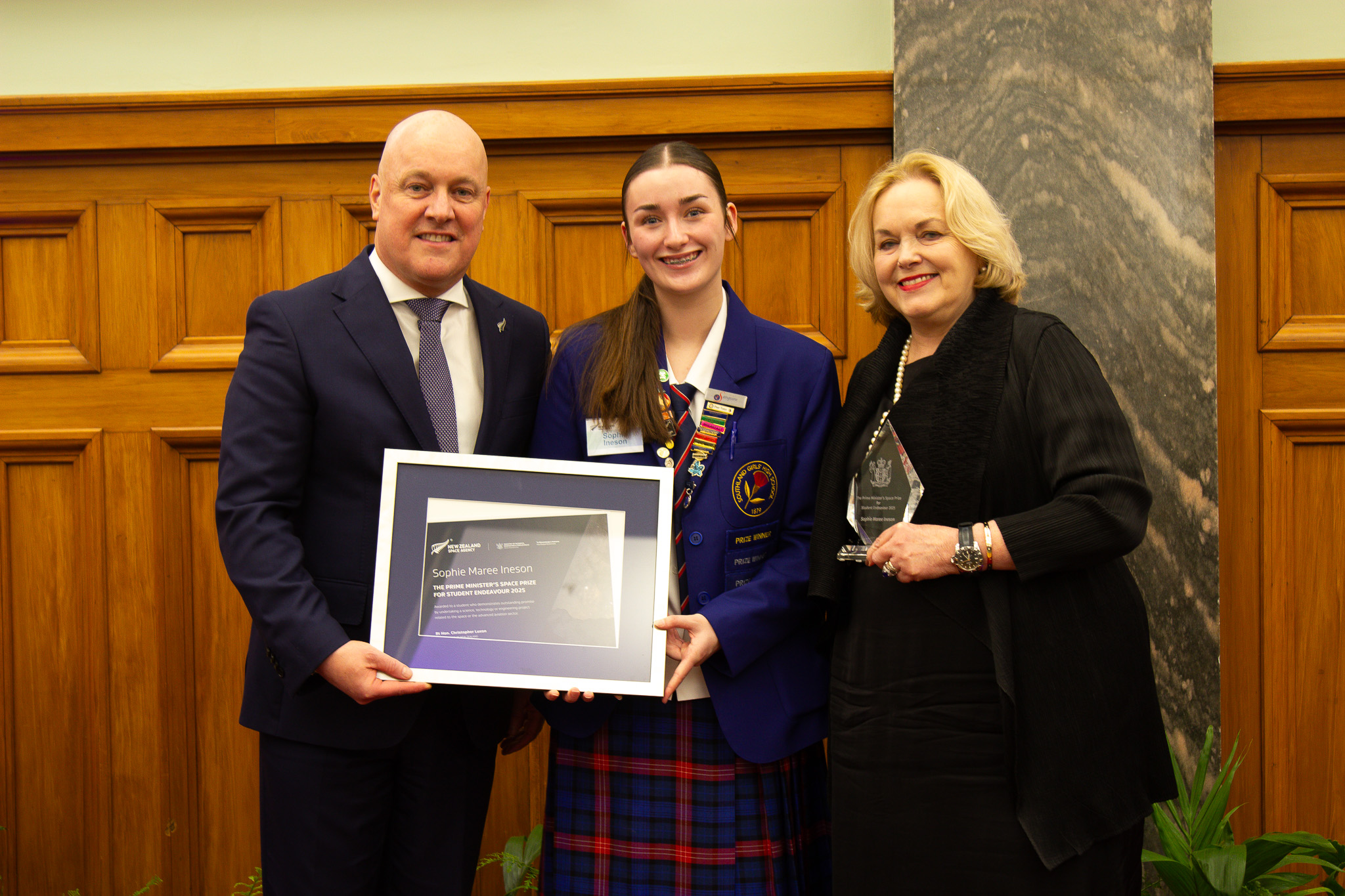
Now, the senior Southland Girls’ High School (SGHS) student has won the $50,000 Prime Minister’s Space Prize for Student Endeavour for her Hydro-Heal project, designing a two-layer hydrogel wound dressing with an outer shield and inner contact layer.
The project involved nearly nine months of research and trials and started after Sophie learned that in microgravity, wounds heal more slowly, slowing tissue repair and increasing the risk of infection.
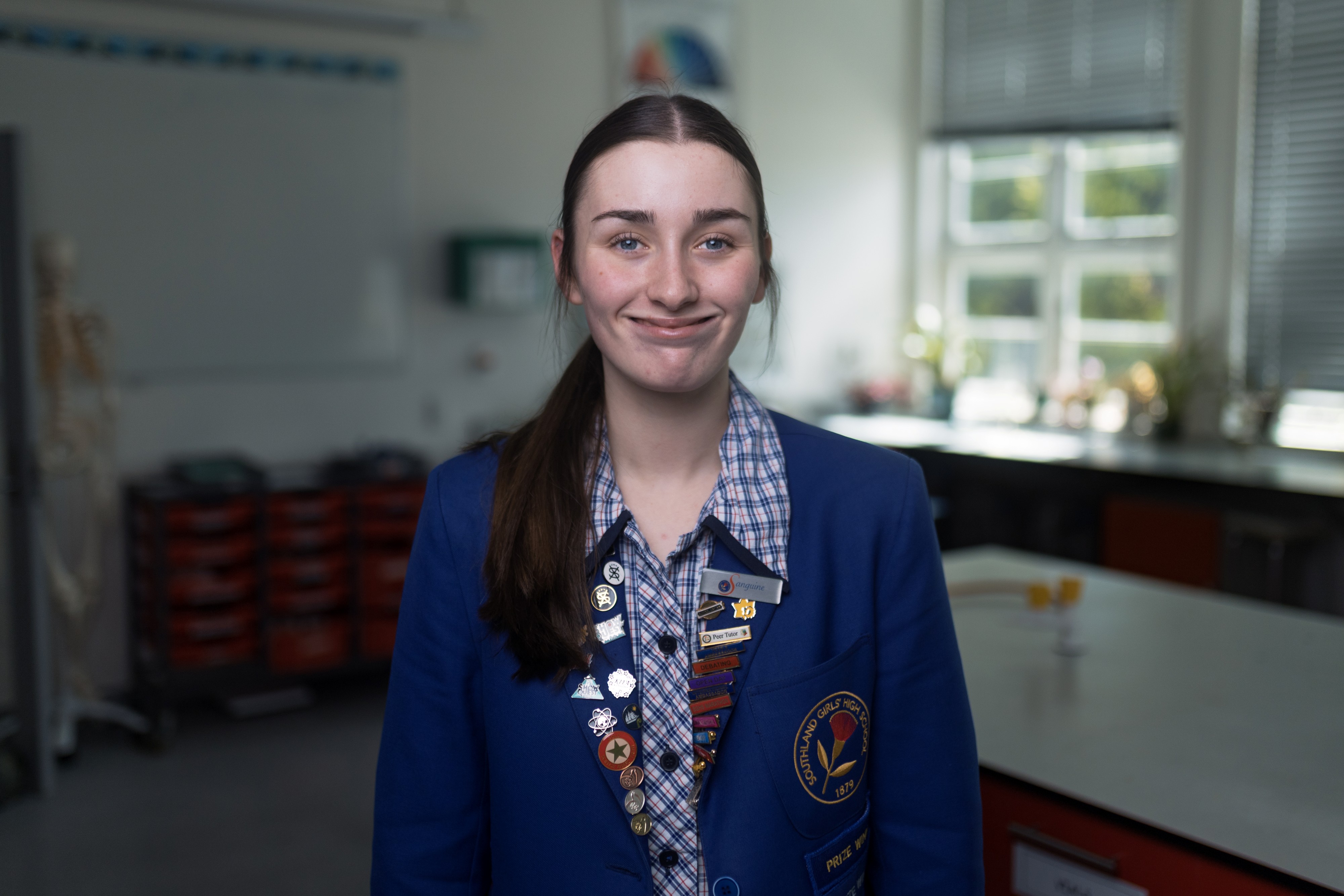
Southland Girl's High School student Sophie won the Prime Minister's Space Prize for Student Endeavour.
Nurturing an early interest in science
Sophie says a variety of experiences, from attending a Nanogirl show to an inspiring trip to NASA in America in 2018, piqued her curiosity in science and shaped her pathway at school.
”After I came back from NASA I entered the science fair and I did a project about what colour space suits will conduct the most heat or keep the astronaut the coolest. From there I’ve entered the science fair every single year,” she says.
One of the first competitions Sophie entered was the Fair Go Consumer Hero Scheme which was designed to get more women into space science. Sophie, Year 7 at the time, won the competition and earned money and a printer for her school, along with a video call with Rocket Lab for herself and her peers.
“Not only is that influencing me, but it’s also influencing other people within the school,” she says.
Sophie has also twice won the NASA Scientist for a Day writing competition, winning two telescopes – one of which she donated to the Deep Cove Outdoor Education Trust so other students have the opportunity to experience it too.
A foundation of support
Sophie says her teachers at SGHS have continuously supported her passion.
“The teachers I’ve had at school have never shut me down or have never said that my ideas are too big. Maybe they’ve rerouted me slightly, but they’ve never said no, you can’t do that.”
Brenda Goodwill, Head of Science at SGHS, says when the school became the first Year 7 to 13 state girls’ school in 2005, Year 7 and Year 8 students were immersed into the science curriculum in laboratories by science-trained teachers.
“Sophie arrived as a Year 7 student already curious about science in general but quite passionate about space. As a school we provide access for students to complete science badges through the Science Awards Scheme. This allows students at a younger age to explore different areas within science,” she says.
Brenda says the astronomy badge was one of the first that Sophie completed.
“It wasn’t solely science that created her pathway. It was also engagement and curiosity across the social sciences, dance and performance, and opportunities through clubs and societies,” she says.
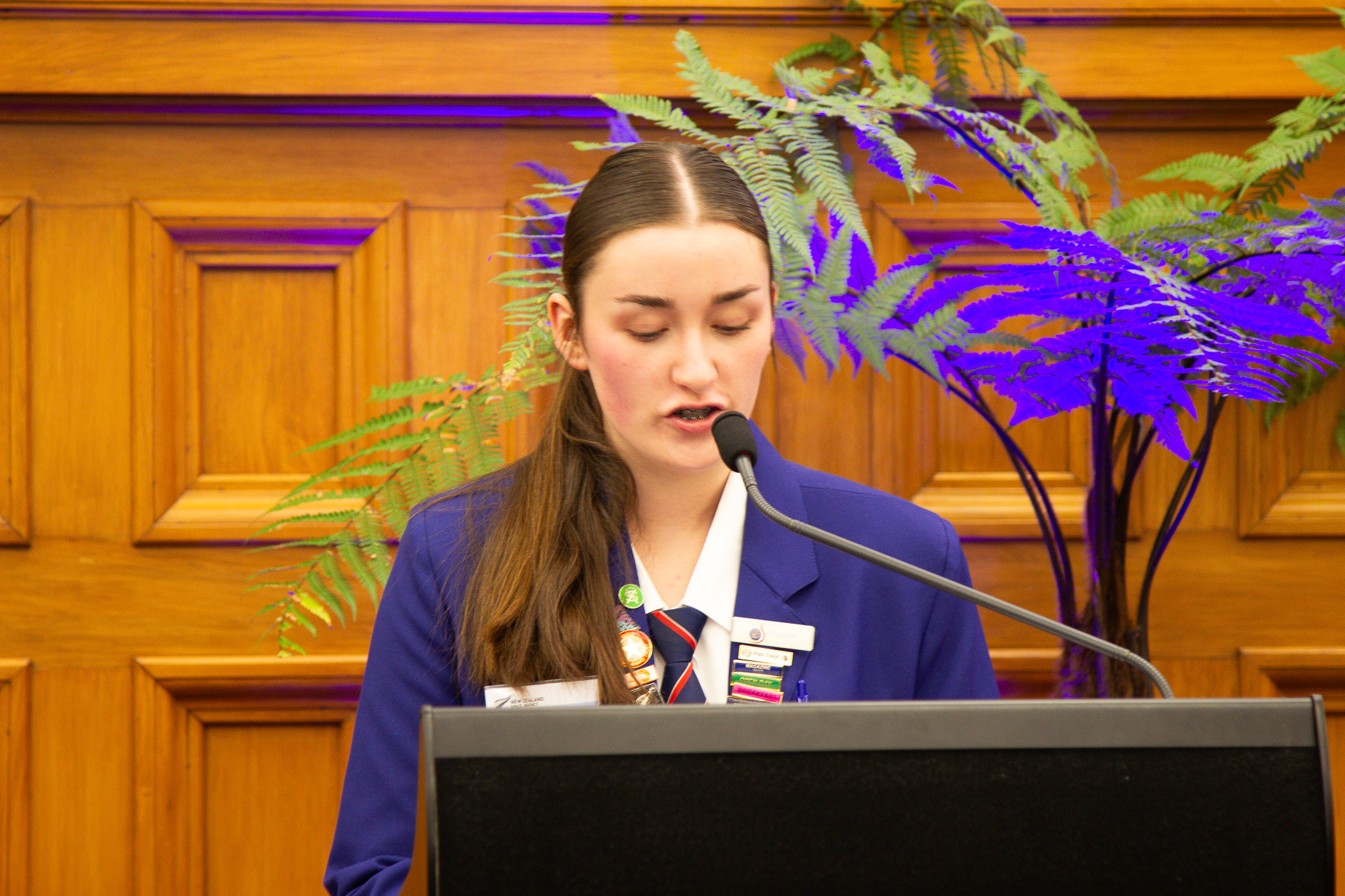
Sophie's interest in space has been nurtured from a young age.
Sophie says one of the key ways SGHS supported her was allowing her to multi-level. In 2024 as an NCEA Level 1 student she completed Level 2 dance and biology. This allowed her to do more of the subjects she enjoys during the time she has at school.
She has now completed Level 3 dance, allowing her to pick up Level 3 biology this year.
“I’ve ultimately been able to fit in a whole subject that I wouldn’t have been able to do if I wasn’t allowed to multi-level,” she says.
Brenda says having the student at the centre of their learning journey is key to their success.
“This means that their age doesn’t determine their level of learning. SGHS offers both New Zealand Curriculum and IGCSE Cambridge Curriculum for Year 9 and 10 students in English, mathematics, science and global minds. Students who show that they are academically capable can move ahead of their year group.”
Reaching for the stars
Brenda says she was “beaming” when she learned Sophie had won the Prime Minister’s Space Prize.
“Nominating Sophie in an area of her passion was easy and in winning this prize it validated her effort, perseverance and out of the box thinking. I was especially pleased that the amount of time that Sophie had invested in her project had been recognised by the judging panel.”
Sophie with Prime Minister Christopher Luxon and Minister for Space Judith Collins.
Sophie was “overwhelmed with happiness” when she discovered she’d won and is excited to give back to her community through the innovateHER club she started for students in Year 7 to Year 10.
“I have a real interest in taking science further and working through investigations. I learn so much from these experiences so I wanted to make sure others could see how they could extend their interests too outside of our classroom lessons. I thought maybe it’s because they’re just not aware of the different opportunities or topics that are actually considered science, that they could enter in a science fair,” she says.
“I definitely wanted to encourage the younger students at school, not only to open their eyes to what is science, but also hopefully spark something within them that science may be the path for them.”
And, as they were with many of her other ideas, the school and science department were behind her.
“Sophie spoke about creating a science club that no doubt sprang from her realisation that with a little bit of encouragement, a passion for science similar to hers would be kindled in other students who have similar curiosity and questions that might not be answered by curriculum learning,” says Brenda.
“We’ve come to learn that 99 percent of Sophie’s ideas are good ideas. We gave Sophie the physical and academic space to create this club and created a Google Classroom where I could view her ideas.”
Sophie says she has already seen an impact.
“We’ve got quite a big number of juniors who had entered the science fair for the first time in quite a few years, which was pretty awesome to see that I had helped start that.”
The future is bright
This year Sophie is taking Level 3 biology, chemistry, psychology, statistical maths and English.
She says while the Prime Minister’s Space Prize sparked an interest in neuroscience, during the school holidays she spent time at Hands-On Otago, a week-long residential camp for senior secondary school students at the University of Otago.
Sophie says she is now “really interested” in pharmacy and psychology.
“Hands-On was a fantastic week, I learned so much as pharmacy was my major and I met amazing mentors within pharmaceutical science.”