How ākonga are shaping the spaces where they play and learn
Across Aotearoa, students are not just learning in their environments, they’re helping shape them. Whether it’s building a shelter, designing a sandpit, or transforming donated materials into imaginative play spaces, tamariki are engaging in real-world design, problem-solving and teamwork.
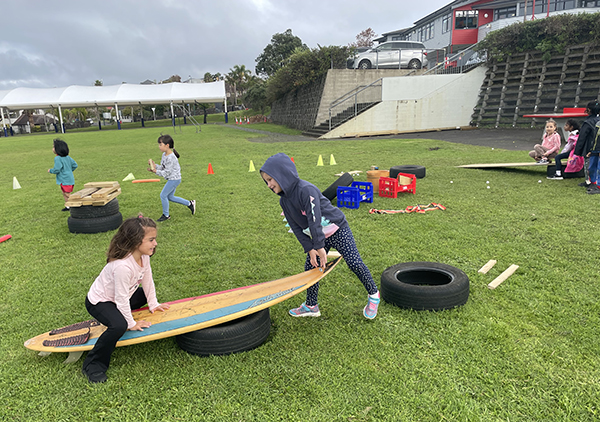
Pinehill School ākonga use a surfboard and tyre to make a seesaw.
At Pinehill School in Auckland, play has always been more than just a break between learning blocks; it’s an essential part of learning.
A few years ago, junior students experienced the Junky Monkeys play initiative as part of EOTC, and staff saw firsthand how unstructured, imaginative play fosters collaboration, risk-taking, innovation and problem-solving.
As students reflected on the experience – how much they loved it and wished they could do it every day – the idea for something more permanent began to take shape. That was the spark for the Creative Playbox.
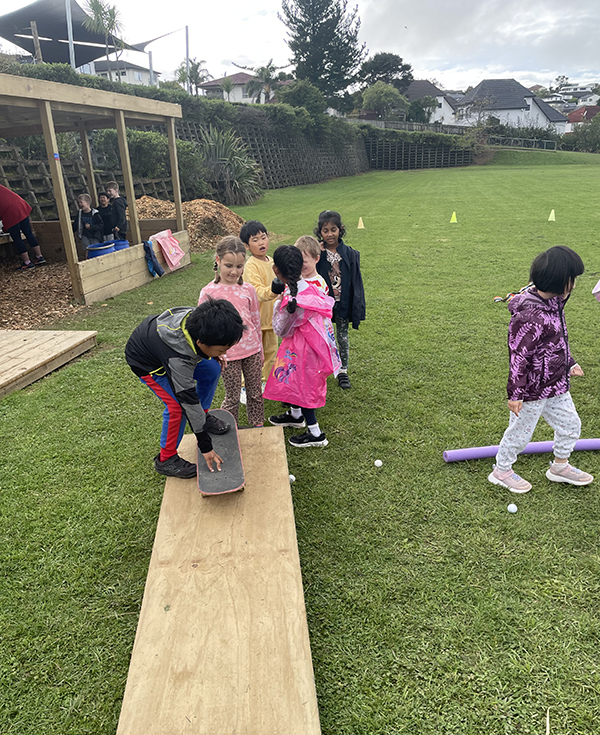
Pinehill School ākonga work together to create games and play – and test their balancing skills.
With the support of the Board and the incredible efforts of property manager Mark Skeath, the Creative Playbox came to life; complete with donated materials, sinks, a repurposed oven, and endless opportunities for play. This space has become a hub of exploration, where students create, build and problem-solve using real materials.
The students themselves describe the Playbox as a place where imagination comes to life.
“When I play in the play box, I can be creative,” says Hudson, 6.
Ava, also 6, enjoys the freedom to invent. “I like that we can use our imaginations and make things up.”
Jeremy, 7, is drawn to the mud kitchen, where “I love making mud soup in the kitchen and using water to make waterfalls.”
Their creations are as varied as their ideas. Hudson built “a big marble run with tyres, pool noodles, and other stuff” with his friends. Emma, 5, made “a strawberry pie for my teacher,” while Ava and her friend used a surfboard and a tyre to make a seesaw.
Jeremy recalls, “We made a ship out of tyres, crates and pool noodles,” during a game of pirates.
Often, play begins with a spark of inspiration. “I was holding a noodle and my friend said I looked like a pirate, so we started to make a ship,” says Ava.
Emma adds, “We didn’t plan it, it just happened.”
Jeremy notes that, “Sometimes we get ideas when we see what other people are making.”
Through play, students are learning to share ideas, take turns and solve problems.
“I have learned to be creative,” says Hudson. Ava says, “I have learned how to play with my friends.” Jeremy reflects, “I have learned how to make things balance and not fall over,” and Emma adds, “I have learned to share ideas and take turns.”
Principal Carla Veldman says, “We’ve watched our tamariki flourish through creative, meaningful and joyful play, ensuring they develop the skills, wellbeing and confidence to carry forward in their learning journey.”
From the ground up at Paparoa Range School
At Paparoa Range School on the West Coast, a similar story unfolded, but this time sparked by a student-led campaign for a better sandpit.
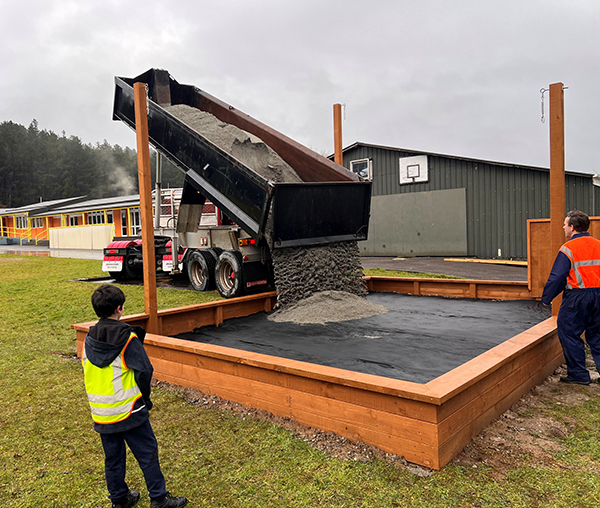
Paparoa Range School student Jackson watching the sand delivery and waiting to help spread the sand out into the new sandpit.
When principal Hamish Lancaster started at the school, one of the first things he learned from students was that they wanted a proper sandpit. At the time, the only option was three standalone garden planters filled with fine gravel, which students didn’t enjoy.
In term 1, senior students wrote letters to Hamish asking if the school could explore the possibility of building a real sandpit. Their voices were heard.
The school was fortunate to have a student teacher with a background in building, who took on the sandpit as a special project. He created a workbook for senior students to work alongside him. Using an aerial map of the school, students identified the best location, sketched designs, calculated materials, drew perspective sketches, developed a materials and equipment list, calculated costs, identified hazards and helped with the build.
Local businesses donated materials; parents and staff pitched in, and the home and school committee contributed $1,500. The result is a 5m x 7m sandpit with an activity wall and space for a mud kitchen that was officially opened at a school assembly in term 4.
“This activity was a great exercise in hands-on, real-life learning that was engaging and exciting for our learners,” says Hamish. “It’s something we would love to do again in the future with another group of students.”
Shelter and inclusion at Renew School
At Renew School in Whangārei, a Year 10 technology project became a blueprint for how student-led, real-world learning can reshape school culture. What began as a simple question about community needs evolved into a full-scale design and build project that bridged learning areas, boosted student confidence, and inspired future initiatives.
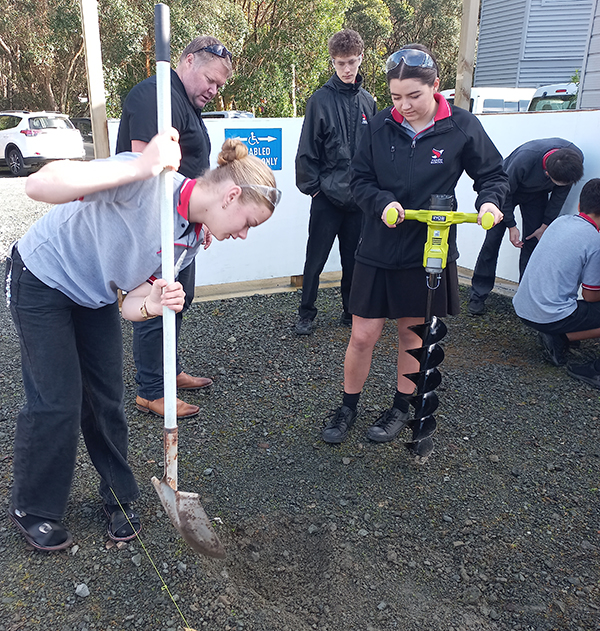
The need was clear: students had no dry, sheltered space to wait for pick-up at the end of the school day. Students took ownership from the outset. They developed a concept, pitched it to school leadership and created a detailed budget covering materials, tools and fees. They sourced quotes from local suppliers and drafted funding proposals for community trusts and school grants.
Acting as project managers, designers and advocates, they demonstrated not only technical and financial literacy but also persuasive communication and teamwork. The final design was shaped with input from the wider school community, and construction took place over two hours a week.
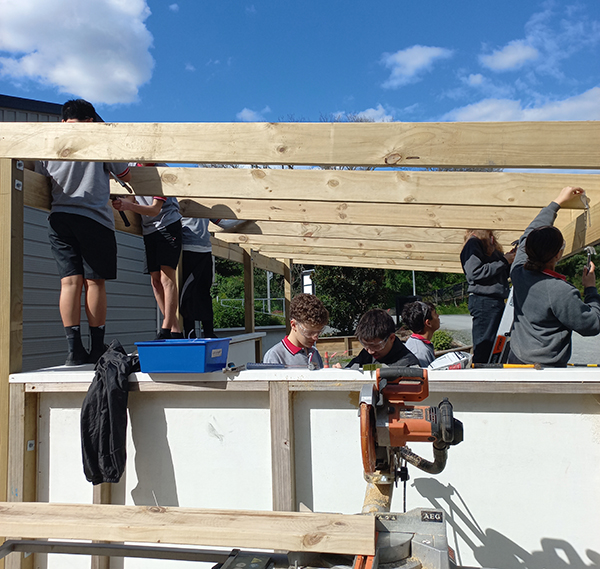
Students at Renew School help build the shelter.
Students applied knowledge from across the curriculum. Maths supported measurement and angles. Science informed structural integrity and material choices. Social studies provided context around regulations. Physical education contributed teamwork and group dynamics.
Associate principal Bruce Alison says, “Over the course of the project, I saw a major shift in student confidence and engagement. It was remarkable to witness students who initially struggled with basic tasks like using a shovel or taking measurements, grow more assured in their abilities.”
One moment stood out as particularly meaningful: the involvement of a student who is visually impaired. Bruce says it was “awesome” to watch how other students supported her to not just participate but thrive.
“It’s incredibly powerful that she was able to use power tools, climb ladders and dig holes.”
Year 10 student Giselle reflects on the experience: “We all decided together so we didn’t really have roles, but I helped with the layout and design.” Her favourite moment? “Screwing on the roof or when the girls dug a hole in half the time the boys did even though there’s like double the amount of them.”
She also saw how classroom learning connected to the project. “Maths helped a lot because of measurement and angles. Visual art also helped a lot for the painting aspect of the shelter.”
Bruce believes the shelter project has opened minds across the school to what is possible.
“These years can be disengaging if not taught with passion and consideration for what students want from their schooling. I think primary schools do project-based learning really well and secondary teachers can reflect on the great learning that can take place in that space.”
He encourages other school leaders to consider student-led, real-world projects.
“It needs to have someone willing to think outside the box. More than anything, I find it requires a change in mindset. Where is there need in our school community? How can we involve or get students to lead change in this area?”