Disability careers expo opens doors to life beyond school
Held on a school day for the first time, the regional ‘What’s Outside the Box?’ disability careers expo invited young people with disabilities and their whānau to explore future possibilities with confidence, creativity and community support.
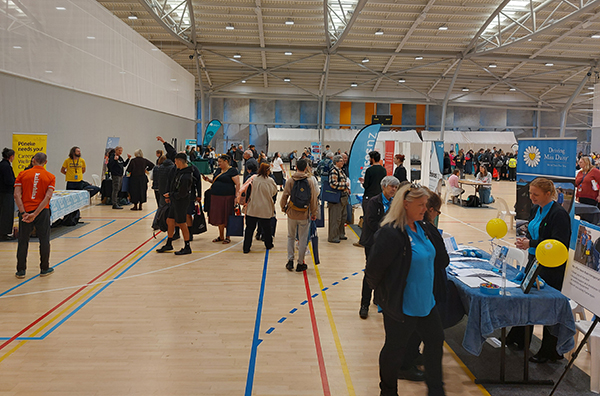
The centre packed with people looking at over 50 stalls
On 2 September, the Ākau Tangi Sports Centre in Wellington was transformed into a vibrant, inclusive space for the fifth annual ‘What’s Outside the Box?’ disability careers expo. It’s a regionwide event designed to help young people with disabilities and their whānau explore what life after secondary school could and should look like.
With over 50 organisations in attendance, the expo offered a one-stop-shop environment for discovering pathways in education, employment, community engagement and independent living.
From driving services and financial support to technology, advocacy and wellbeing, the event showcased a broad spectrum of tools and services available across the Wellington region.
Sparking deeper engagement
This year marked a significant shift: for the first time, the expo was held on a school day.
According to Naomi Yeoman, general manager of Well-Able Disability Information & Equipment Services and leader of the expo working group, this decision was based on feedback from previous years.
“We know that an expo environment does not suit everyone, so this is only one way to access this information,” says Naomi.
“However, it provides an opportunity to talk face to face with a wide range of services in one place, substantially reducing the time needed to explore the available options.”
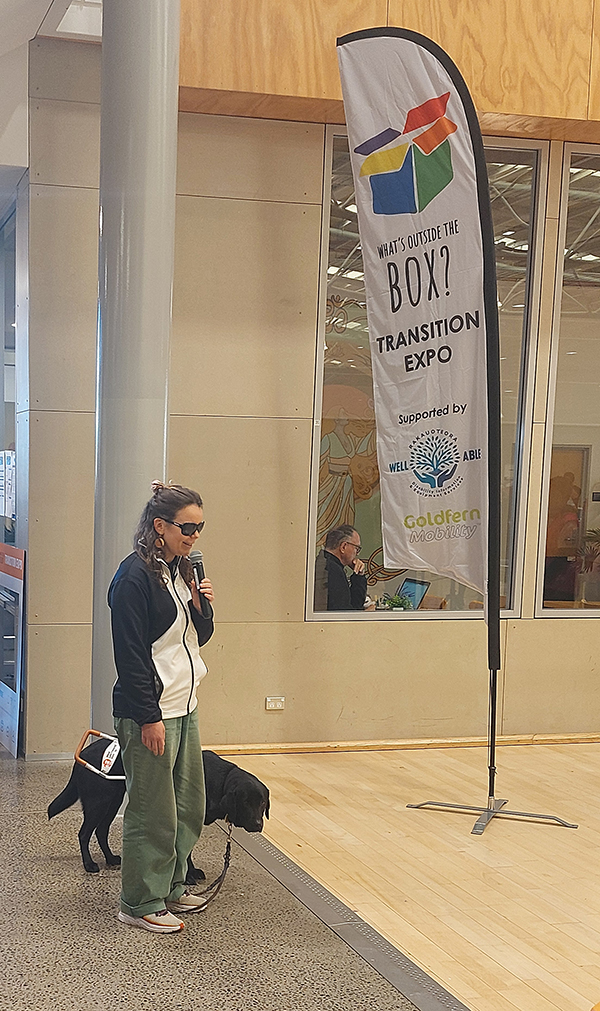
The expo offered a one-stop-shop environment for discovering pathways in education, employment, community engagement and independent living.
The change paid off. Schools from across the region attended, including Hutt Valley High School, which brought 16 students from its Tautoko Supported Learning Centre.
Head of Tautoko, Heather Lear, says the experience was invaluable.
“I was motivated to bring our students to the event because it’s really important that they have the opportunity to explore future pathways over an extended period of time rather than leaving it until the last minute when there is the inevitable anxiety around life beyond school,” says Heather.
“It’s a great, interactive event that makes the ‘What’s Outside the Box?’ question less daunting.”
How students responded
Heather’s students responded positively, engaging confidently with stallholders and asking thoughtful questions.
“There was genuine interest in our students as they explained about their organisations and how they might be able to link with them in the future,” she says.
One standout moment came when a student recognised a driver from Driving Miss Daisy, recalling a previous experience with joy. “It was like seeing a long-lost friend,” shares Heather.
Alongside Naomi, the expo was also supported behind the scenes by Caroline Campbell from the Ministry of Social Development, Donna Clark from Mahinawa Specialist School, Mathias Bridgman from I.Lead and Margaret McNally and David Hibberd from the Ministry of Education.
Real-life connections that complement classroom learning
The expo complemented the transition work already happening at Hutt Valley High. Heather explains that transition planning begins early, with students in Years 9 and 10 starting to take responsibility for independence tasks. By Year 11, they begin engaging with the community.
Senior students participate in the Sustainable Networks and Pathways (SNAP) programme, supported by Year 13 mentors. This includes exploring skills, interests, and values, and running a student-led business: SNAP Frozen, an ice cream enterprise.
Students also take part in OWLS (Opportunities with Life Skills), a weekly programme focused on cooking, household tasks and community access.
“This term we have two students who are leaving school this year participating in an overnight AirBnB ‘Go Flatting’ experience, using money raised through SNAP Frozen,” says Heather.
“The most important element in preparing our students for leaving school is that it is done slowly, at a manageable pace, over time.”
Heather notes that one student who used to panic at the idea of leaving school is now willing to have conversations about next steps. The expo helped spark new ideas and possibilities.
Students finding next steps
One student discovered Thumbs Up, a potential next step previously thought out of reach. Another learned about the Disability Business Network, which could support her in using her art skills for future enterprise initiatives.
“The expo complements the work we are doing in school because it provides real-life links with the community,” says Heather. “It provides a stepping stone between school and beyond.”
Heather is now looking to bring organisations like People First, ReCreate, and Tu Matau Ora into the school to run workshops and build stronger community links.
“Schools and communities can work together by building relationships,” she says. “We need to know who to contact directly, who can come into school to talk to students and whānau, where we can take our students to visit in the community, and for organisations to become more aware of the individual needs of students in our current climate.”
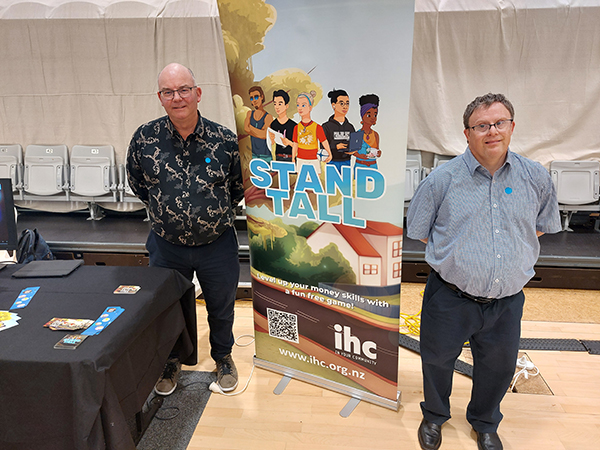
Two men stand on either side of a sign advertising the game Stand Tall
Interactive learning and inclusive fun
The expo also featured presentations on health and wellbeing, individualised funding, employment rights, and support funds. Light-hearted activities from Special Olympics, Nuku Ora and WI Dance added to the welcoming atmosphere.
Among the exhibitors was Phil Clark from IHC, showcasing ‘Stand Tall’, a budgeting game for people with intellectual disabilities and neurodiversity.
“Some educators already knew about the game and used it regularly in transition classes, and others who were just learning about it were surprised and excited that they could use it for their students,” says Phil.
“Occupational therapists are especially enthusiastic. When they discover Stand Tall, they often light up thinking of someone who could benefit.”
Expo is a powerful way to connect
Phil says the expo is a powerful way to connect with key professionals. “Parents at the expos are often surprised and delighted to discover that a game can be educational. It opens new possibilities for learning and engagement.
“These expos help us make meaningful connections with key professionals, especially teachers and transition support staff, who are looking for practical, engaging tools for their students.”
For Naomi, the expo is about more than showcasing services; it’s about reducing anxiety and supporting rangatahi.
“In a period of so much change and uncertainty for rangatahi, we want to reduce the level of anxiety involved with planning for this next step and equip them with the knowledge of what’s available locally, so they can feel more positive about exploring what’s next.”
For more information about the expo, visit the Well-Able Disability Information & Equipment Services website.
The transition workbook that comes out of the event can be found here: Electronic Transition Booklet.
Read more about Hutt Valley High School’s SNAP Frozen programme in Education Gazette 103.12: Ice cream team – How Hutt Valley High School is helping students look to the future.