Ākonga develop an AI tool that supports learning, not shortcuts
Three Marlborough Boys’ College business studies students have developed an artificial intelligence (AI)-powered tool to support students with their writing, not do the writing for them. A finalist in the regional Young Enterprise Scheme (YES), WordFrame already has subscribers from around the motu.
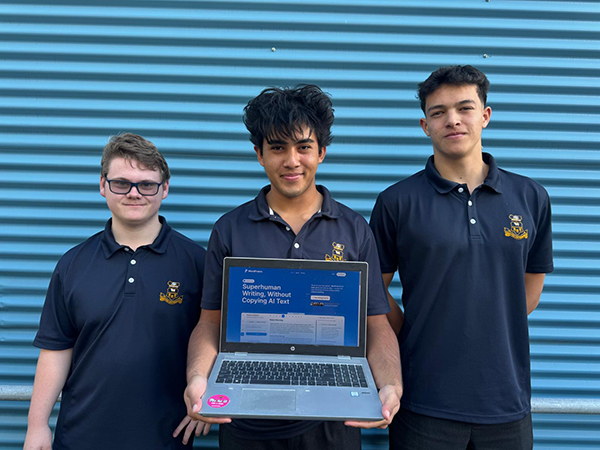
Lawrence, Sanjiv and Kahu created AI tool WordFrame as part of their Level 2 business studies class.
"The benefits of AI are too good for students to ignore.”
When Marlborough Boys’ College students Sanjiv, Lawrence and Kahu had to come up with a business idea for their Level 2 business studies class, they turned to AI – not to provide the answers for them, but to develop a solution for others.
Having observed that AI was widely used by their peers, they wanted to find an option that kept students engaged in their learning.
The result was essay helper, WordFrame.
“Within education, AI needs to help you learn instead of doing the work for you,” explains Sanjiv.
“We understand that its generative nature makes it easy to copy entire paragraphs and essays, but by doing so we will lose the critical thinking and learning aspect of school itself. AI should simply be a tool, not a shortcut.”
Ministry of Education Manager NCEA Henry Collette, agrees that for students, the use of AI tools must be restricted to make sure students submit their own work.
He says AI tools should also never replace professional judgment or predict grades.
“In NCEA, achievement decisions are made by teachers based on evidence of what students know and can do. Those decisions are moderated against national standards.
“While AI can provide feedback, it cannot determine grades or guarantee outcomes. Students and teachers should use AI responsibly as a learning aid, not as an assessor.”
The start of something big
Marlborough Boys’ College business studies teacher Joyce Kumar says the project began with suggestions and discussion around the creation of new business ideas.
“From a curriculum perspective, the goal of the project was for students to apply their understanding of business knowledge and concepts to develop an innovative and sustainable business idea.”
Joyce says students were expected to take the lead in every aspect of their enterprise, from developing their innovative idea to designing and implementing the business plan.
“They managed their own roles, delegated tasks and made decisions collaboratively, showing initiative and resilience. My role was to mentor and guide them, but the leadership and direction of the project remained student driven.”
For the students, developing WordFrame involved “design and tedious code”.
“Kahu designed our visual branding while Lawrence and I planned the technicalities of our app,” explains Sanjiv.
“After deciding its features and costs, Kahu was tasked with designing rough wireframes for the visual layout. I used Cursor as my IDE (integrated development environment) to code the wireframes into a functional prototype.
“Lawrence constantly ran tests to make sure each feature was behaving as it should and that everything was working correctly. We repeated the process of building and testing until we reached a polished version ready for release.”
Sanjiv took on the chief executive officer role and led the team to use their strengths.
“I have a pretty strong understanding of how to build an MVP (minimal viable product), prove validation, market the product and retain customers.”
Lawrence oversees the tracking of profitability and expenses as chief financial officer while Kahu felt his best fit was as creative director.
“I enjoy getting to shape the visual image of WordFrame, including our colour palette and branding.”
Made by students, for students
Joyce says AI is currently used by Marlborough Boys’ College students for research, planning and developing ideas, while teachers use it for feedback and classroom support.
“It helps promote creativity, problem-solving, and independent thinking.”
Before its release, WordFrame was tested by students and teachers at Marborough Boys’ and Marlborough Girls’ colleges.
“Testing it in a real school environment allowed the students to see how their idea worked in practice and make small improvements based on feedback,” says Joyce.
“Many have commented that this is brilliant and innovative… The students themselves are now using the app for their English write-ups, which shows its versatility and usefulness beyond business studies.”
Lawrence says WordFrame’s point of difference is that it is made by students for students, “so we understand what is needed in the market”.
“We are trying to help students to learn to write with AI instead of getting AI to write.
“They can also ask simple questions so they can continue writing for longer periods of time rather than going onto other websites to find out their answer.”
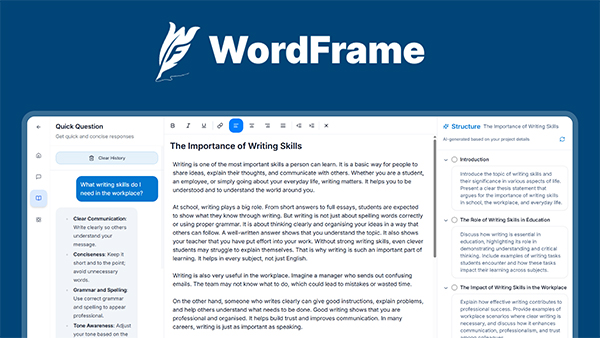
Kahu says students can use WordFrame’s structure guide to help outline sections of an essay.
“We figured the name ‘WordFrame’ suited our product because its main selling point is that it helps students structure their work properly,” he says.
Then, says Sanjiv, if a student wasn’t too sure how to improve their draft, “they could use our feedback tool to see their current grade and what to work on”.
“WordFrame has been my partner throughout most of my internals, helping me reach Excellence in almost every one of them. I used the structure guide to outline my reports, and used the feedback tool to improve my drafts. The research tools were also useful whenever I needed to know a quick fact.”
A winning product
As part of their class, WordFrame was entered into the 2025 Young Enterprise Scheme (YES) for Nelson Marlborough. YES provides a mentor and engagement with the wider business community, giving ākonga real-world experience in developing and running a business.
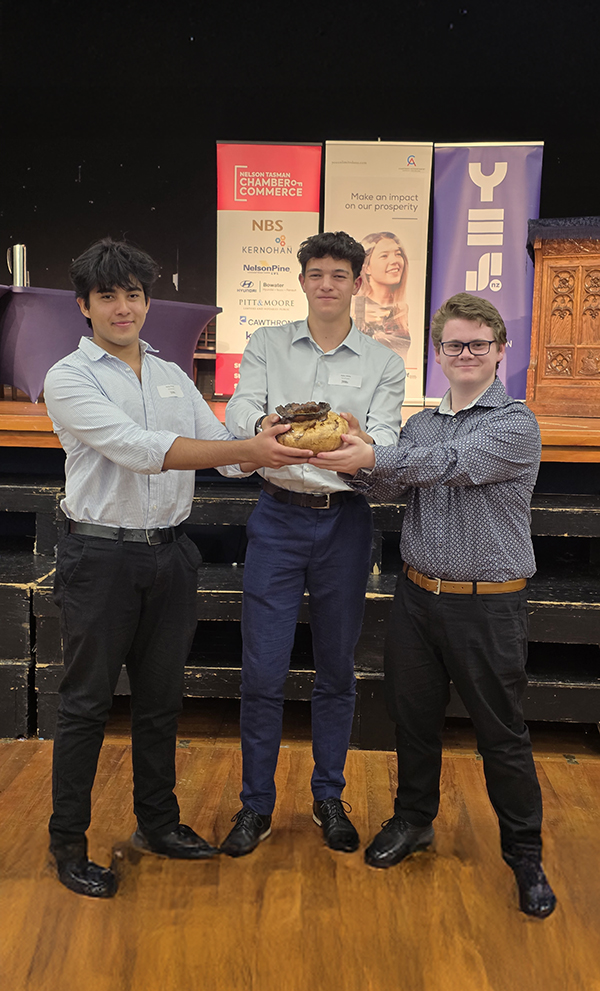
The WordFrame team received the Best Annual Review award 2025 at the Young Enterprise Scheme (YES) regional finals for Nelson Marlborough.
WordFrame won the first two challenges and, in October, received the Best Annual Review award 2025 for the top of the South. The team will continue to compete in YES next year with WordFrame.
Lawrence says YES gave him insight into the business industry and “how my future could potentially look”. Kahu adds the programme helped him gain more of an understanding of how businesses like theirs operate and market.
A key challenge was juggling the YES project with other curriculum requirements and internal assessments, says Joyce.
“As the YES programme required them to take full leadership, I had to step back at times and let them make their own decisions, which wasn’t always easy… I also had to guide them in refining their sustainability ideas so that they were not only environmentally responsible but also practical and financially achievable.”
Growing into the future
For Joyce, WordFrame has demonstrated how, when used responsibly, AI can complement teaching and help students innovate.
Sanjiv says the project has taught him about accessibility, “and getting people to use your app”.
“Our platform is great and a really appreciated concept, however, transitioning users from Google Docs into a whole new platform can be overwhelming. We need to simplify and make access and usage a whole lot easier if we want to get more users.”
“Realising the issues with our current app, our approach next year is expected to be incredibly strong and successful,” says Sanjiv.
Lawrence says they will remove boundaries by using a ‘freemium’ model and making the product ‘super easy’ to use.
The goal is to get as many users as possible and focus on volume, says Kahu.
Beyond the secondary school market in New Zealand, the WordFrame team founders are looking to tertiary and global curriculums.
“WordFrame will develop by going into other markets such as the American market for their high schools and colleges,” says Lawrence.
Sanjiv says the future goal is to make ethical AI accessible and used “by the majority” while Lawrence adds that AI is “inevitable” in the workforce.
“If students are using AI such as WordFrame to help them, then it shows that they are actually learning the material while getting a realistic experience of what it will be like beyond school,” says Lawrence.
“Point is, you will never be able to ignore AI,” adds Sanjiv. “It is our future, and students will always eventually turn to it. It is our job to accept this and point them in the direction of ethical usage.”
Explore the tool: WordFrame - Ethical AI Writing Tools for NCEA Students.
Schools are required to have a policy on the use of AI. The Ministry of Education and New Zealand Qualifications Authority (NZQA) strongly encourage schools to engage with their published guidance on AI. This provides principles-based, practical advice for school leaders, teachers and students.
Generative AI - Ministry of Education
Guidance on the acceptable use of Artificial Intelligence - NZQA