Food is fuel: How Healthy School Lunches keep ākonga going
Ever wondered what it’s like running Aotearoa New Zealand’s biggest food programme? Education Gazette takes a peek behind the scenes at the challenges and opportunities in feeding learners across the motu.
“The Healthy School Lunches programme is so much more than what you think,” says Ministry of Education’s general manager strategic programmes, Andrew Gibson.
“While the overall focus is very clearly to feed hungry school children, we’re finding that there are so many more positives emerging.
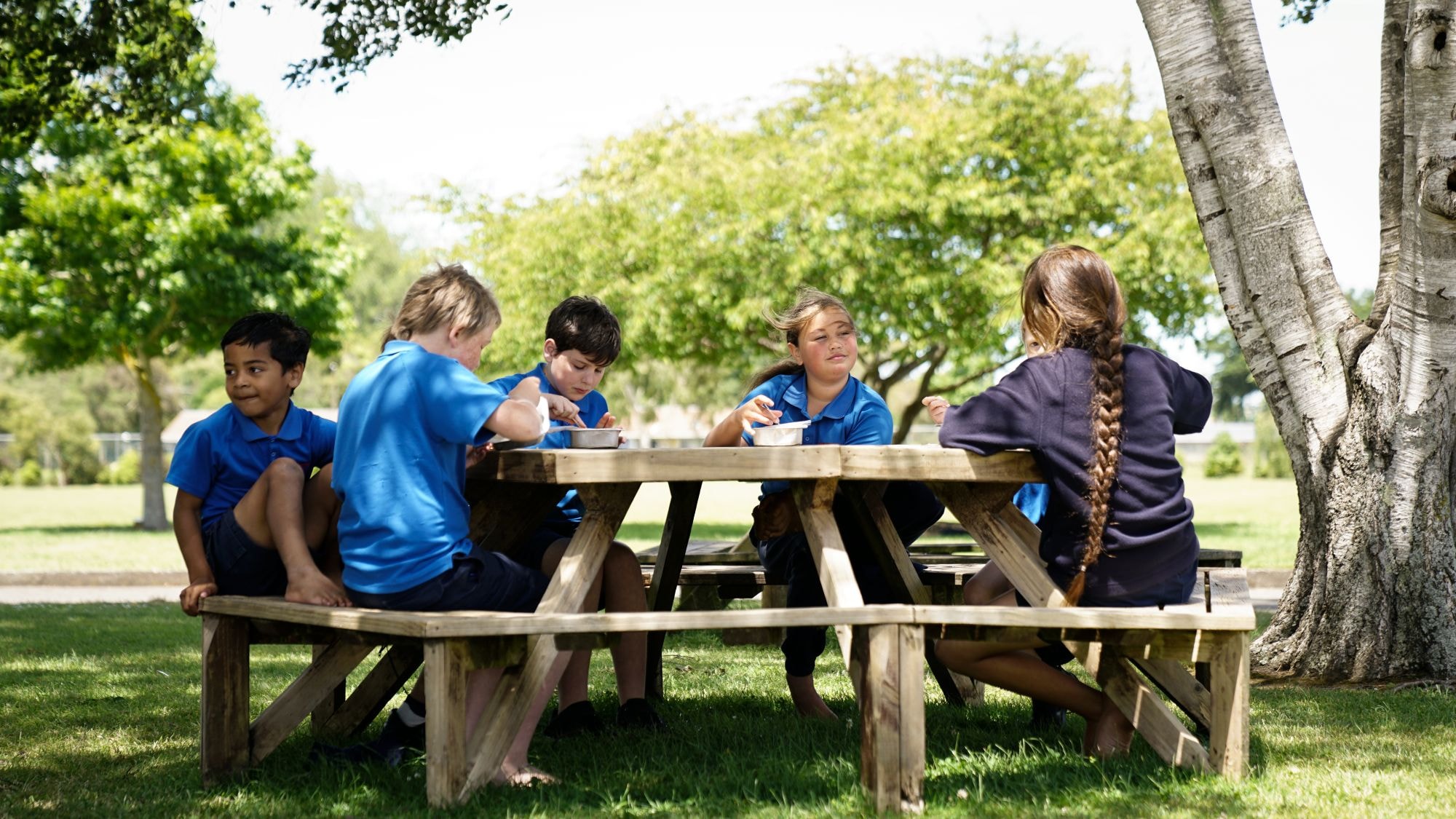
“Lots of schools are telling us they’re seeing less ‘hangry’ behaviour and more positive engagement of students in the classroom. They’re also seeing more social literacy develop – a new positive culture coming through when students sit together, have a communal kai karakia, and chat while eating with their school whānau.
“The benefits are more than food.”
Some students are trying new foods they wouldn’t have the opportunity to try at home, he continues, listing additional benefits. They are developing a new understanding of how food is prepared, as well as learning about how nutritious food keeps them fuelled and going during the day.
Launched in 2021, Healthy School Lunches has always had a focus on nutrition, says Andrew.
“We’re always looking for ways to make sure meals meet nutritional standards but are appealing to our young people; hot meals stay hot, and don’t decline in quality before serving.
“The suppliers we work with have chefs, nutritionists and even dietitians on their team. They work really hard to make sure every meal is fit to be put in front of students.”
It’s no mean feat, with the programme catering such a large number of meals across over 1,020 schools and student preferences every single day – and making sure they’re delivered in time for lunch.
Lots of schools are telling us they’re seeing less ‘hangry’ behaviour and more positive engagement of students in the classroom.
Different models and new challenges
What many people don’t know about Healthy School Lunches, says Andrew, is that there isn’t just one-way lunches are prepared and delivered.
Every school week, the programme delivers more than one million meals to over 240,000 students across the country through three different delivery models for schools.
“There’s an ‘external’ model which delivers lunches each day to schools around the country from commercial production kitchens of varying sizes,” he explains. “Some suppliers provide thousands of meals each day and some only deliver to a few schools.
The ‘internal’ model makes lunches in school kitchens of varying sizes, kitchens at the school. Some internal model schools also make lunches for neighbouring schools and deliver them each day.
“Then we also have local partners providing lunches to ‘iwi hapū’ model schools and kura.”
In Budget 2024, a new challenge was thrown at the programme: it had to look at a new way to deliver lunches and find efficiencies across the programme.
“We had an expert advisory group get to work straight away. They put the existing model under the microscope, examining what might be changed,” says Andrew.
“They talked to schools, suppliers, stakeholders and members of the food industry about what works well and what doesn’t. They researched other school lunch models used around the world.”
With this new model needing to be in place by term 1 2025, the Ministry of Education went to market to find suitable meal suppliers while the advisory group was still finalising details of the model.
There was a robust, transparent procurement process, and many wholesalers and suppliers submitted proposals in response,” explains Andrew. “Across New Zealand, we found lots of suppliers who stepped up and were willing to meet the challenge.
“There was only three months between the final contract being signed and when the first meal was due to be delivered for planning and working out finer details – including summer holidays and Christmas!”
Never losing sight of the objective
Like any new national-level programme on the scale of the Healthy School Lunches, the first term encountered challenges needing to be navigated in real time.
The per-meal cost was initially scrutinised when it launched, and there were lots of logistical hurdles for suppliers, explains Andrew, reeling off a list.
“They had to consider travel routes, different arrival times at every school, meal orders, speciality student needs. There were changing delivery numbers due to varying school start dates, teacher-only days, illnesses, roll changes, and other school events each term that made delivery challenging.”
One of the biggest hurdles for suppliers and schools, however, is the need to balance the familiar with new meals – roughly one in three students only eat meals they recognise and feel familiar with, while some students always want new and different meals.
On top of that, most students want hot meals, especially in colder months, but others prefer cold meals or just snacks.
How does the Ministry know?
“We’re always collecting data to give us the information we need to run a food programme at this size and make important decisions,” says Andrew. “There is always more to do and we’re always working to improve the programme.
“We’ve learned so many valuable lessons along the way,” he adds, “but we never lose sight of the objective of making sure that students in participating schools who need a lunch get one.”
We ask meal providers to use reusable, recyclable, or compostable packaging.
Working to reduce surplus and waste
As well as information on what is and isn’t wanted on a menu, the Ministry of Education has been working to identify surplus – the number of untouched meals leftover after lunch.
“Measuring this before 2025 was manual and limited and we didn’t really understand the drivers,” explains Andrew. “We’ve since learned that surplus is complex. There are many factors that contribute to it.”
From feedback, the Ministry of Education now knows that surplus comes from meal order numbers needing to be constantly updated to accurately reflect how many students are attending school. It comes from children getting bored with the same menu items (both how the food looks and tastes), and how the lunches are talked about in school and outside of it.
“Student voice is such an important part of getting the meals right,” says Andrew. “All of the suppliers are tuned in to hear what the children like and don’t like about school lunches.
“Meals are tested with students before being added to menus and meal providers ask what they could be doing differently to make kai that the students want to eat.”
Since early 2025, there have been systems in place to give the Ministry better data. They clearly outline expectations for surplus measurement in supplier contracts and school agreements.
“This helps us to reduce leftover lunch numbers,” says Andrew. “In turn, we can put money and resources back into the programme to keep improving it and invite more eligible schools to join.”
A similarly tricky thing to keep track of, end-of-lunch waste (partially eaten meals and all packaging) relies on all students to put their waste in the correct bins.
“We ask meal providers to use reusable, recyclable, or compostable packaging, and make sustainable choices by composting food waste, or feeding scraps to animals,” explains Andrew.
Always innovating
Started by the idea that if students at school had full stomachs, they could learn and thrive, Healthy School Lunches is always looking ahead to the future.
“The programme continues to evolve, and we know that there is lots of work to do to keep our students fed with nutritious food, thriving and succeeding,” says Andrew.
The Ministry of Education is working to build a model to find all students in need, no matter what school they attend. It is also piloting different ways to run the programme, so that it can reach even more children living in need.
The programme is always evolving and improving “to achieve our objective of reducing the impact of food insecurity in school”, says Andrew.
“Our map for this programme has, and always will have, students at the centre.”