A tapestry for life: In honour of the late Tā Tamati Reedy and Lady Tilly Reedy
In March this year, Aotearoa New Zealand mourned the passing of Lady Kahurangi Tilly Te Koingo Reedy (Ngāti Porou) (1934-2026). Then sadly in May, Tā Tamati Muturangi Reedy (Ngāti Porou) (1936-2026) also passed.
They were deeply respected leaders, educators and advocates for Māori language and education. Their vision and expertise were instrumental in shaping Te Whāriki. We honour their legacy and life, and the taonga that continues to shape generations. In this tribute, Emeritus Professor Helen May reflects on the vision, leadership and enduring impact of Tā Tamati and Lady Tilly, and the weaving of Te Whāriki as a foundation for mokopuna in Aotearoa
A tribute by Helen May
Sir Tamati and Lady Tilly Reedy, on behalf of Ngā Kōhanga Reo Trust, worked alongside Margaret Carr and me on our contract to develop National Early Childhood Curriculum Guidelines.
The 1991 proposal to the Ministry of Education included a Māori curriculum with a separate working group, along with working groups for Pacifica, home-based, infants and toddlers, young children and children with special needs.
Thus in late 1991 we began our extraordinary journey with Tilly and Tamati, beginning with the framework of the five domains of Mana that became Te Whāriki – as a ‘mat for all to stand on’ but woven with multiple curriculum patterns.
In hindsight this was radical; a curriculum woven by all kaiako, grounded in the peoples and places of Aotearoa with the principle of empowerment of mokopuna at its heart.
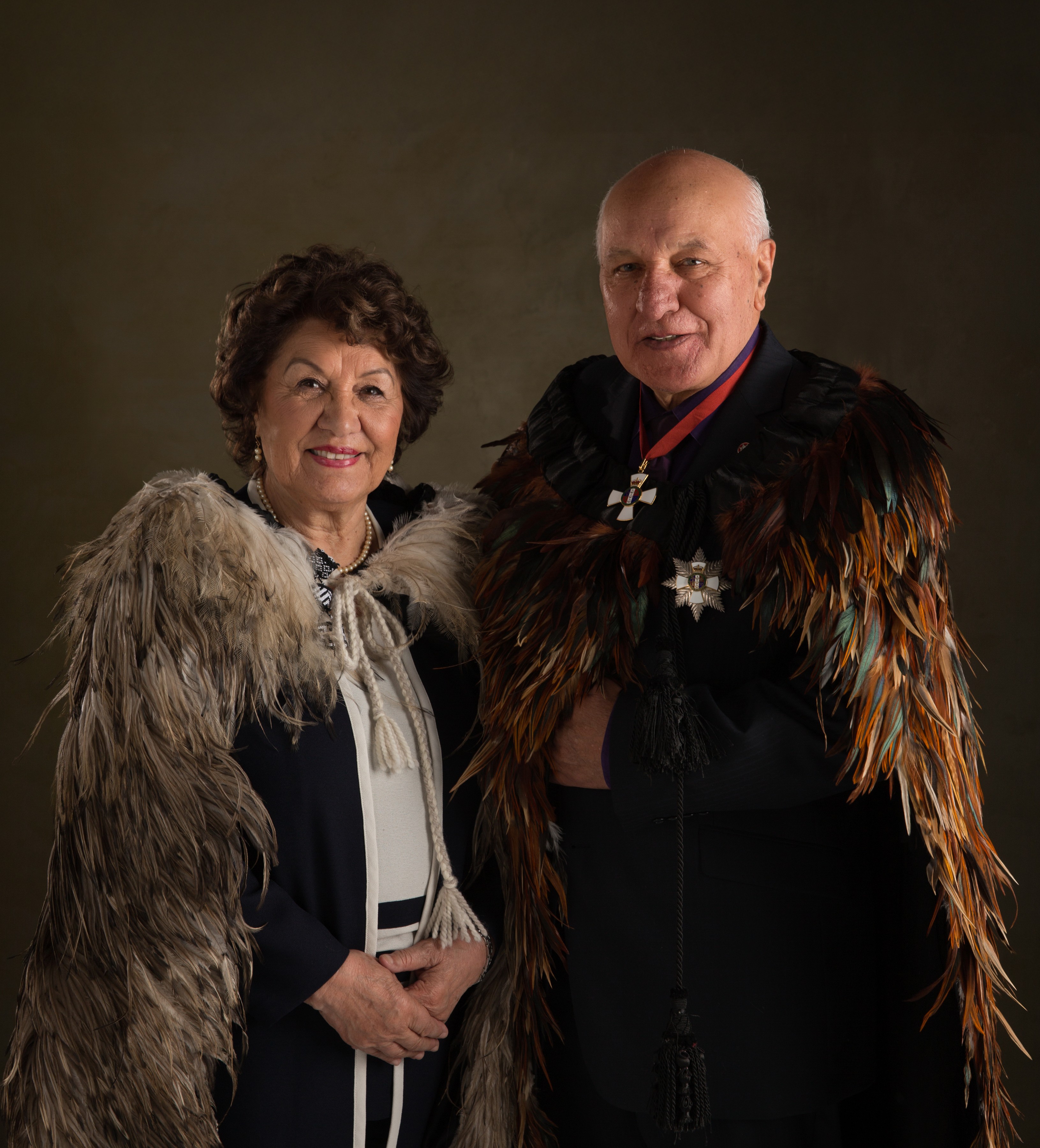
Lady Tilly Reedy and Tā Tamati Reedy photographed at the time of Tamati receiving a Knighthood in 2011. Image: Catherine Cattanach Photograph
Both Tilly and Tamati had a way with words. Separately and collectively, across the decades, they translated, promoted and protected Te Whāriki.
Tilly’s way with words was her expressive ability to charm, challenge, cajole and explain. This is not to forget Tamati’s scholarship, knowledge and translations that guided us so well.
It was, however, Tilly, with her hands-on experience, who was more often on the frontline. She spoke at many hui, mainly unscripted and always feisty.
Tilly fronted the Ministry of Education’s first consultation hui in late 1991 with a ‘who’s who’ of academics, teacher educators and organisation leaders, and unveiled the framework of Te Whāriki with its four principles and the domains of Mana Atua, Mana Whenua, Mana Reo, Mana Tangata and Mana Aoturoa – what did they mean?
There was a stunned response as Margaret and I then outlined the parallel domains of: Wellbeing, Belonging, Communication, Contribution and Exploration. These were also new words. Preschool curricula were mainly framed around play areas, apparatus or subjects.
Gaining acceptance of the principles and dual framework from these cross-sector power brokers was a huge step.
It was Tilly’s speech ‘I have a Dream’ that launched Te Whāriki at the CECUA Conference in 1993 after the draft was posted without fanfare to centres.
"I have a dream that we, the Māori people of Aotearoa will secure our place here in Aotearoa through our commitment to our mokopuna," she said.
That we would be celebrating ‘Te Whāriki at 30 Years’ (after its official launch by Prime Minister Rt Hon Jim Bolger in 1996 at the Beehive) was never imagined.
In 2004 the OECD Directorate of Education organised a workshop for national coordinators of early childhood policy that showcased Te Whāriki as ‘groundbreaking’. In 2013 New Zealand hosted a conference, again for OECD member early childhood policy makers who requested a focus on Te Whāriki.
After a mihi whakatau and an introductory mihi by Riripeti Reedy, Lady Tilly and Sir Tamati opened proceedings. Their speech, ‘Te Whāriki: A Tapestry for Life’, in the presence of the Hon Hekia Parata, a first Māori Minister of Education, was a powerful message to this international audience.
Tilly spoke first, echoing the missive from a 1995 keynote, ‘Power and Knowledge set me Free’: “Te Whāriki encapsulates my horizon and the dreams I have for my mokopuna’s heritage. It can be your horizon too … Te Whāriki recognises my right to choose, and your right to choose.”
Tamati followed, translating what the domains of Mana meant for all mokopuna in Aotearoa
You can read the speech: