Te Pou Ārahi: A culturally grounded approach at Hamilton Girls’
When Hamilton Girls’ High School’s Aotea Apiti travelled to Montana State University for an Indigenous knowledge exchange, she found herself sharing more than a teaching framework. Presenting Te Pou Ārahi on an international stage showcased the values, relationships and cultural foundations that shape teaching and learning at HGHS, while revealing strong common ground between Indigenous communities separated by thousands of kilometres.
In July, a delegation connected with Te Ao Hurihuri at the University of Waikato travelled to Montana State University for a culturally immersive programme focused on Indigenous education, relationships and knowledge sharing.
A key event during the visit was the inaugural REDTalks summit, hosted by the Native American Studies Department at Montana State University.
Bringing together Indigenous academics, educators and students from the United States, Canada and Aotearoa New Zealand, the summit explored cultural sovereignty, Indigenous research, self-representation and the role of higher education in supporting Indigenous communities.
Among the speakers was Aotea Apiti, Hamilton Girls’ High School head of department Te Tari Māori.
Her presentation focused on Te Pou Ārahi, also known as ‘The HGHS Way’, a shared pedagogical framework developed by the school to create a more consistent and culturally grounded approach to teaching and learning.
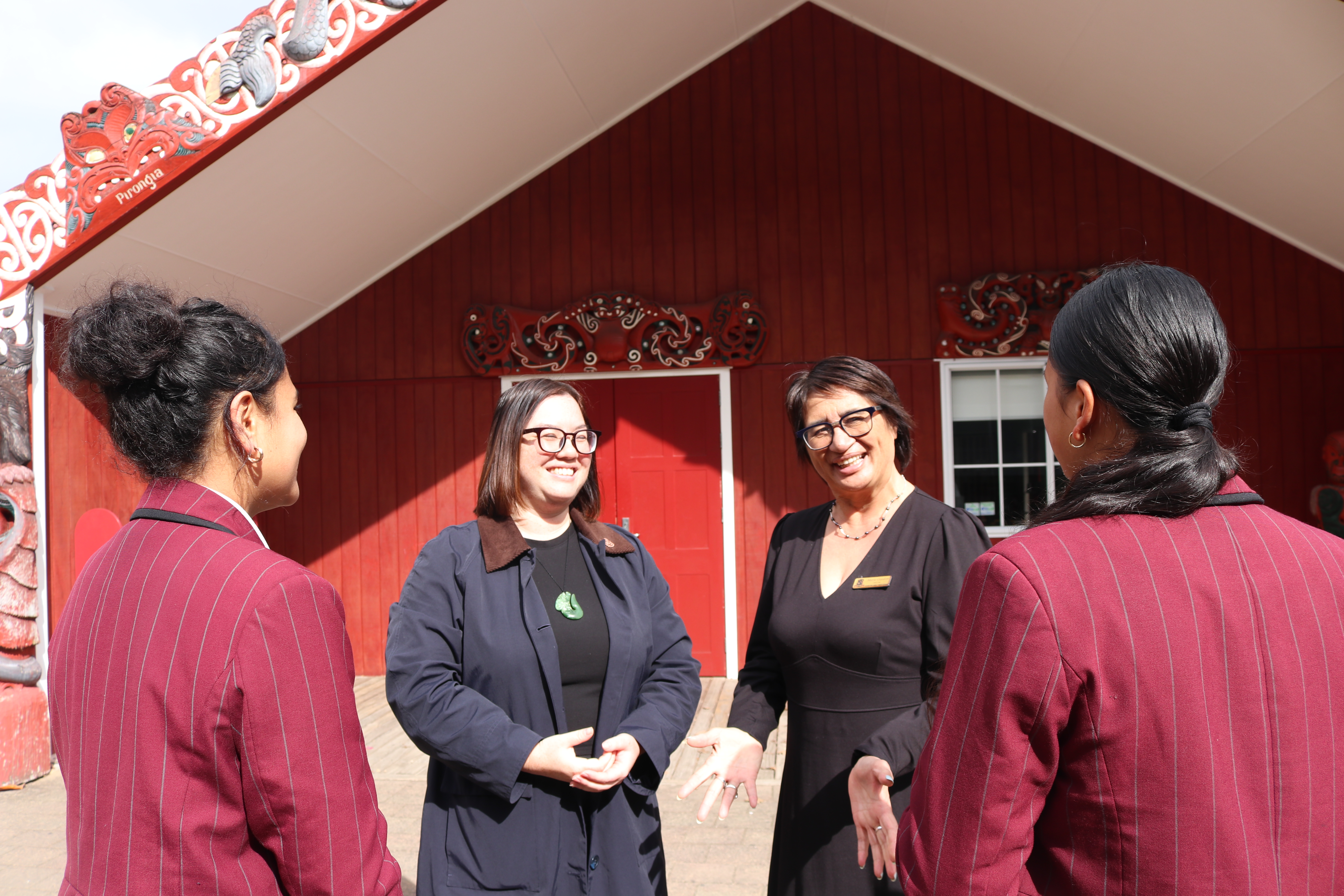
Hamilton Girls’ High School head of department Te Tari Māori Aotea Apiti (middle left) with principal Marie Gordon and students.
Baskets of knowledge
Explaining Te Pou Ārahi to an international audience meant sharing the knowledge, values and aspirations that sit at the heart of learning at Hamilton Girls’.
Each morning, students in Whānau Māori begin with a karakia that recalls the journey to Rangitūhāhā to obtain the three baskets of knowledge, a journey associated with Tāne-nui-a-Rangi in this karakia and with Tāwhaki within Tainui traditions.
The story provides an important metaphor for learning at Hamilton Girls’. Knowledge is not just something received. Its real value becomes apparent when it is shared and used to help us all flourish.
That whakaaro sits strongly alongside Te Pou Ārahi, the school’s pedagogical framework.
Developed as the ‘HGHS Way’ of teaching and learning, its evolution has been a collective effort, led by principal Marie Gordon and shaped by kaiako across the school.
It is grounded in four mātāpono: Whanaungatanga, Kotahitanga, Manaakitanga and Tika me te Pono.
Together, these values provide a foundation for teaching that recognises the cultural needs and aspirations of ākonga, with the aim of creating meaningful learning experiences.
Marie says Leading to the North East by Russell Bishop “emphasised the way we had to teach and relate to our learners, to drive the change in our kura”.
Teaching the person before the subject
When speaking in Montana, Aotea brought Te Pou Ārahi to life through practical examples rather than theory alone, sharing how its values are embedded in everyday school practice - from creating an environment where students’ names, identities, and cultures are respected, to strengthening relationships with whānau, incorporating karakia, and establishing shared expectations across classrooms.
Importantly, Te Pou Ārahi is not intended to sit on a wall as a set of values. It asks what these principles actually look like in classrooms.
A visitor to Hamilton Girls’ will see kaiako building strong and respectful relationships with students, creating welcoming environments where learners feel known, valued and supported.
They will see teachers drawing on students’ prior knowledge and experiences, holding high expectations, using formative assessment and feedback and adapting their teaching to respond to the strengths and needs of individual learners.
Whanaungatanga encourages teachers to “teach the person before the subject”, learning about students’ interests, cultures and backgrounds, developing authentic relationships and working alongside whānau.
Manaakitanga asks staff to create environments characterised by care, inclusion and respect, while Tika me te Pono challenges teachers to recognise Māori language, culture and heritage as strengths and to reject deficit explanations for learner achievement.
For Marie, leadership and learning are deeply connected.
“Our leadership is measured not by what we achieve ourselves, but by the opportunities we create for others to flourish.”
Te reo Māori and tikanga Māori are central to the foundation of Te Pou Ārahi. Through ongoing professional learning and shared practice, kaiako are supported to strengthen their confidence and capability in engaging with te ao Māori and to reflect this meaningfully within their teaching.
The framework encourages staff to continue developing their own knowledge and practice while creating learning environments that affirm and value Māori language, culture and identity.
Finding common ground
“What stood out to me during my stay in Montana was how much we had in common,” says Aotea.
“Although our contexts are different, there was a strong shared understanding that education is most powerful when it is grounded in identity, relationships, community and Indigenous knowledge.”
The wider Montana programme reinforced those connections.
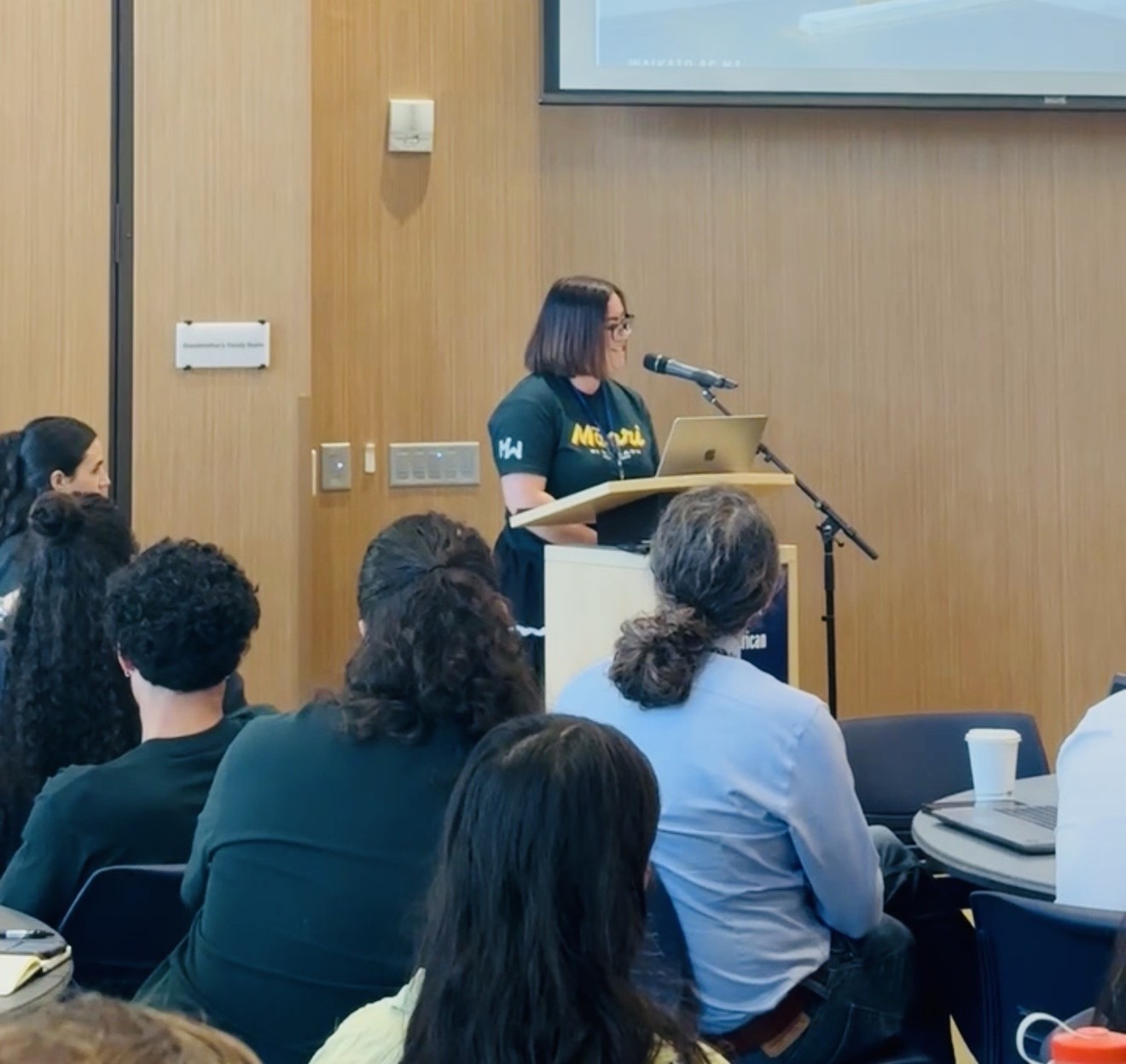
Aotea Apiti presenting on Te Pou Ārahi at the inaugural REDTalks summit.
Participants had opportunities to spend time with Native American communities and learn through practical and cultural experiences.
These included helping to construct tipis, learning about their design and cultural significance, and participating in activities that encouraged deeper conversations about identity, community and the transmission of knowledge.
The group also witnessed a bison harvest, which provided an opportunity to learn about relationships between people, whenua, animals and food systems.
The experience highlighted the cultural significance of the bison and the responsibilities connected with harvesting, preparing and using the animal respectfully.
Participants also learned about sweetgrass, a sacred plant used by a number of Native American peoples in ceremonies and cultural practices.
They were shown how to weave the plant and learned about its significance, including the values and responsibilities associated with gathering, preparing and using it.
For Aotea, these experiences were an important reminder that Indigenous knowledge is not limited to academic discussion.
“Some of the most powerful learning took place through being present, listening and participating,” she says.
“We were able to learn not only through presentations, but through relationships, stories, cultural practices and time spent with community.”
The visit also created space for delegates from Aotearoa and Montana to compare experiences within their respective education systems.
Before travelling, Aotea had been learning about Montana’s Indian Education for All initiative, which requires students to learn about the histories and contemporary experiences of Montana’s tribal nations.
She says this prompted reflection on the ways mātauranga Māori, histories and values are embedded within education in Aotearoa, as well as the challenges involved in ensuring Indigenous perspectives are represented authentically.
An ongoing journey
“It was a privilege to share some of the work happening at Hamilton Girls’ High School, but it was equally important to be there as a learner,” she says.
“The generosity of our Indigenous brothers and sisters in Montana, who welcomed us, shared their knowledge and invited us to participate in these experiences, is something I will carry with me.”
The exchange reinforced an important lesson for Hamilton Girls’ about culturally responsive practice.
“It made me realise that Te Pou Ārahi is not something we ever finish – it is an ongoing journey that we continue to grow together.
“Culturally responsive practice is an ongoing journey we must always take the time to reflect upon and action. It is not a destination reached through a single framework.”
Like the knowledge carried by Tāne, the value lies in what happens when that knowledge is shared, planted and allowed to grow.
Karakia in Whānau Māori Classes at Hamilton Girls’ High School
Tēnei au tēnei au
Ki te hōkai nei o taku tapuwae
Ki te hōkai nuku
Ki te hōkai rangi
Ki te hōkai ō tātou tupuna a Tāne-nui-ā-rangi
I pikitia ai ki te Rangitūhāhā
Ki te tihi o Manono
I riro iho ai ngā kete o te wānanga
Ko te kete tuauri
Ko te kete tuatea
Ko te kete aronui
Ka tiritiria, ka poupoua
Ka puta mai iho te ira tangata
Ki te whai ao
Ki te ao mārama
Tihei-mauri ora