Broader horizons: How a small school made a big curriculum
At Reefton Area School students are learning Korean, Japanese and psychology. Not one of those classes could sit on the timetable on its own without the school taking a networked approach to broadening the curriculum.
West Coast’s Reefton sits inland about halfway between Westport and Greymouth. It’s a small town: total population just over 1,000; total school roll 175.
The secondary school at Reefton Area School is run by just six teachers. It’s not nearly enough to offer a great deal of specialist subjects, and yet the school’s students are learning Korean, Japanese, psychology and more.
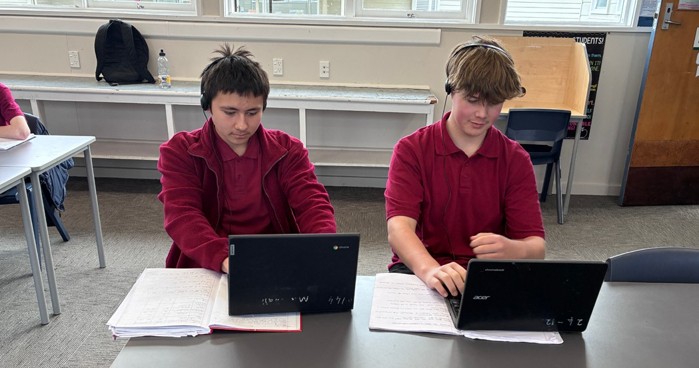
Using NetNZ, Reefton students are part of a community of learners across participating schools. They sit in their own school, with their own people around them – but they take a course taught from another town by a teacher from another school.
Teachers in member schools teach their specialist subject to students across the network, and each school keeps an ‘eDean’ to hold the local end together.
At Reefton Area School, that eDean is Carolyn Milne, a social science and food technology kaiako. She keeps the students who are learning online on track and teaches other students in the NetNZ network.
“As an eDean, I maintain close contact with my students, particularly our online learners,” says Carolyn, though she adds that all of the teachers delivering online courses across Aotearoa also help with engaging and motivating their learners.
“I check in with our Reefton online learners on a regular basis.
“Being a small school helps – I can catch up with them informally as well as formally, for example, in the lunch line as well as after online lessons.”
It’s one of the real benefits of working in a small school, enthuses Carolyn.
“I love the fact that I know my students well and that learning programmes can be highly individualised to meet each of their needs, including accessing learning programmes offered through external providers like NetNZ.”
Learning online means students can access subjects and specialist teachers they wouldn’t otherwise have access to at school.
Growing the curriculum
The subjects available to Reefton students stretch further than what six teachers could ever cover.
“We simply cannot offer every subject that a larger secondary school can offer,” says principal Yvonne Catherwood, who took on leadership of the school in 2025 and is a steadfast supporter of online courses.
“Online learning means that our students can access subjects and specialist teachers that we wouldn’t otherwise be able to provide locally, giving them more opportunities to follow an interest or career pathway.”
“Taking subjects online means a lot to our students and their futures,” agrees Carolyn. “There is demand for specialist subjects at Reefton, and the demand is growing as students increasingly look toward tertiary study – which has not always been the case.
“NetNZ means our students are able to follow a specific career pathway or choose particular subjects needed to move to tertiary study, for example chemistry and geography.”
Yvonne says her biggest hope for Reefton Area School ākonga is that “when our students leave school, they believe that there are lots of possibilities for their future”.
“NetNZ gives our students opportunities that simply wouldn’t exist for them otherwise,” she adds.
“A student sitting in Reefton can be learning alongside students from other schools around New Zealand and working with a teacher who may be hundreds of kilometres away.
“That can really broaden their thinking about what is possible.”
A different way of learning
Yvonne carefully challenges the assumption that online learning is easy.
“I don’t think we should pretend that online learning is automatically easy for every student,” she says.
“It does require a different set of skills. Some students take to it very quickly, while others need more support to develop those skills.
“For some students, the online environment actually suits them extremely well because it gives them a level of independence and responsibility that they enjoy.
“For others, it takes time to develop those skills. Like any form of learning, it is about knowing the student and providing the right support.”
“Some students need more support than others, especially at the beginning of the year,” agrees Carolyn.
“I make sure that these students get the support they need through one-on-one meetings that can be organised to coincide with their timetabled ‘distance learning’ subject line.”
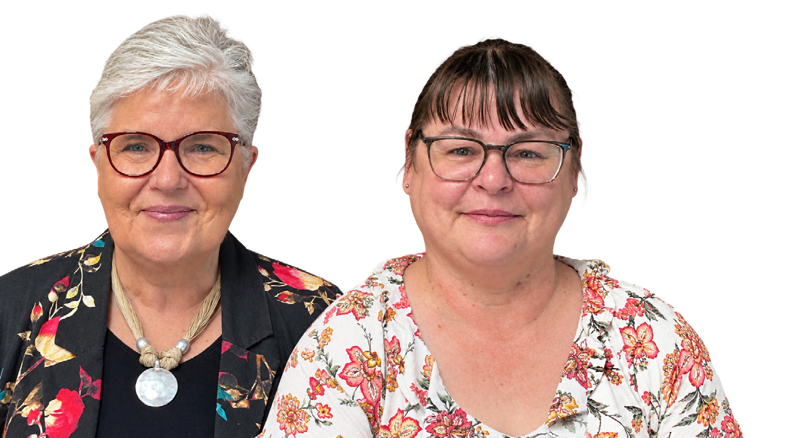
Reefton Area School principal Yvonne Catherwood (left) and eDean Carolyn Milne.
While Carolyn says initially offering online courses can be a steep learning curve “especially if you are a school that is going to contribute staffing by delivering a course” she is quick to encourage schools to make the most of networks of learning like NetNZ and Kotui Ako.
“Take advantage of the vast experience of teachers across New Zealand!”
Yvonne couldn’t agree more.
“Don’t let the size of your school limit your thinking about what you can offer your students.”
Yvonne recommends other schools “choose students carefully” when it comes to providing online courses.
The key, she says, is making sure they understand that online learning comes with responsibility.
“It isn’t an easier option – it is a different way of learning.”
Enjoying the challenges
Day to day, Carolyn says her role as an eDean is similar to a house dean in bigger schools.
“I have a regular flow of students passing through my class to ask questions or to attend their online class in the space adjacent to my classroom.
“I follow up with students who I note have been absent from a class and support them as issues arise – technical, educational or personal. I follow their progress and keep up to date with their grades,
processing results from internals as they come in, and keep in contact with other eDeans.”
She describes her role as being beyond what most people would refer to as organised. In addition to supporting students, she teaches classical studies and says that teaching online requires you to have a plan B and C “in case something goes wrong technology-wise”.
“For every online lesson, you have to think about how your delivery of the curriculum is incorporating your students’ ability to work collaboratively to build knowledge – but also work independently to ensure success.
“You also have to understand how each home school supports their students and how you are going to facilitate the asynchronous portion of the week,” she adds. “But luckily I enjoy these challenges!”
Carolyn says the things she especially enjoys about teaching online engaging such a diverse range of students in a subject they would not otherwise have access to.
“Over the years, I’ve had the privilege of working with English language learner students and some who’ve not felt confident enough to speak online until term 2!”
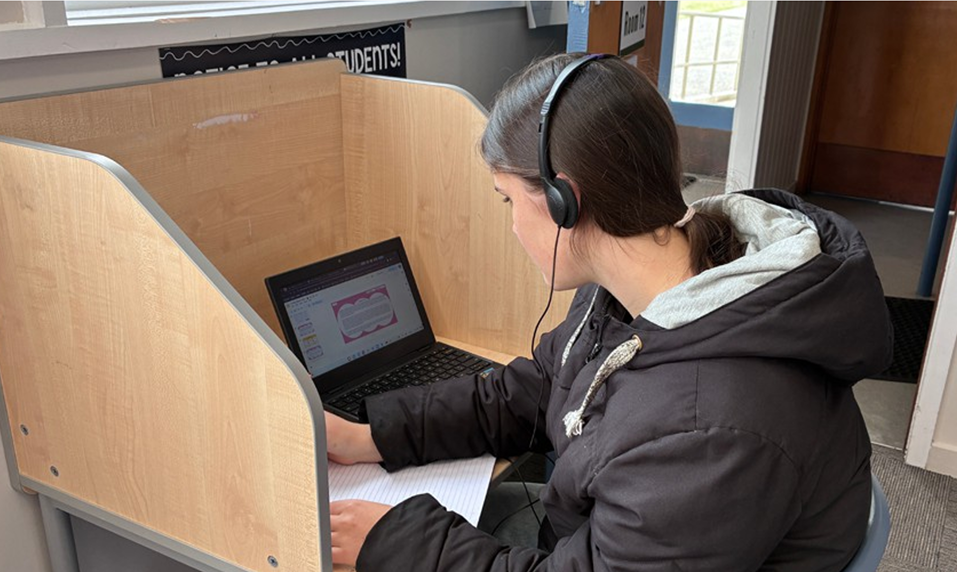
Learning online gives some students a level of independence and responsibility that they enjoy.
Aligning with core values
At Reefton Area School, one te reo Māori student has carried on from last year, two Year 11 students are taking Korean, and one Year 13 ākonga is taking beginner Japanese.
All three, Carolyn says, love what they’re doing. “I am really enjoying learning Korean. I am very grateful that our school can provide such unique learning opportunities for students,” says Year 11 ākonga Sophie.
For Yvonne, offering courses aligns with the schools’ core values and its goals for their ākonga. “Specifically, it ties in with self-management.
Students have to communicate with teachers they have probably never met, work independently and manage their time,” she says.
For some students this is a big ask, says Carolyn. “Students need to be self-motivated and work to keep engaged and succeed in the online learning environment. But often, the process involved in online learning enables students to become more independent in their learning anyway.
“Some students absolutely thrive.”