Voices of principals
Around Aotearoa, school leaders are guiding their teams within the unique contexts of their school or kura and their communities. Three principals share their insights and perspectives on what leadership looks like for them, the opportunities it brings, and the goals that lie ahead.
Nikki Smith, Tumuaki, Granity School – West Coast
I have been principal at Granity Kura for two years now and will be heading into my third year at the start of Term 2 2026 – and wow, what a ride it has been so far.
Principalship was never something I had imagined for myself, but I have always believed in stepping into opportunities when they arise, especially when they offer space for personal growth.
Granity Kura was a part of my professional journey, having worked at the school early in my teaching career and living just minutes away as part of the local rural community. With a mountain view from my office window and the sea stretching out from our school verandah, it truly is an epic place to go to work every day.
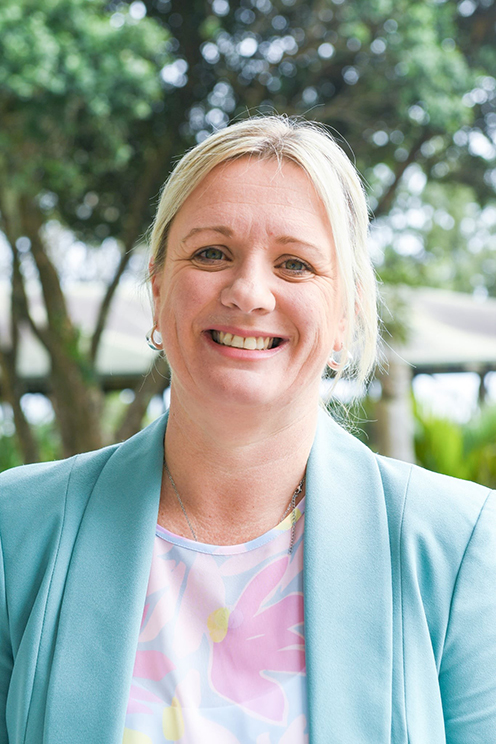
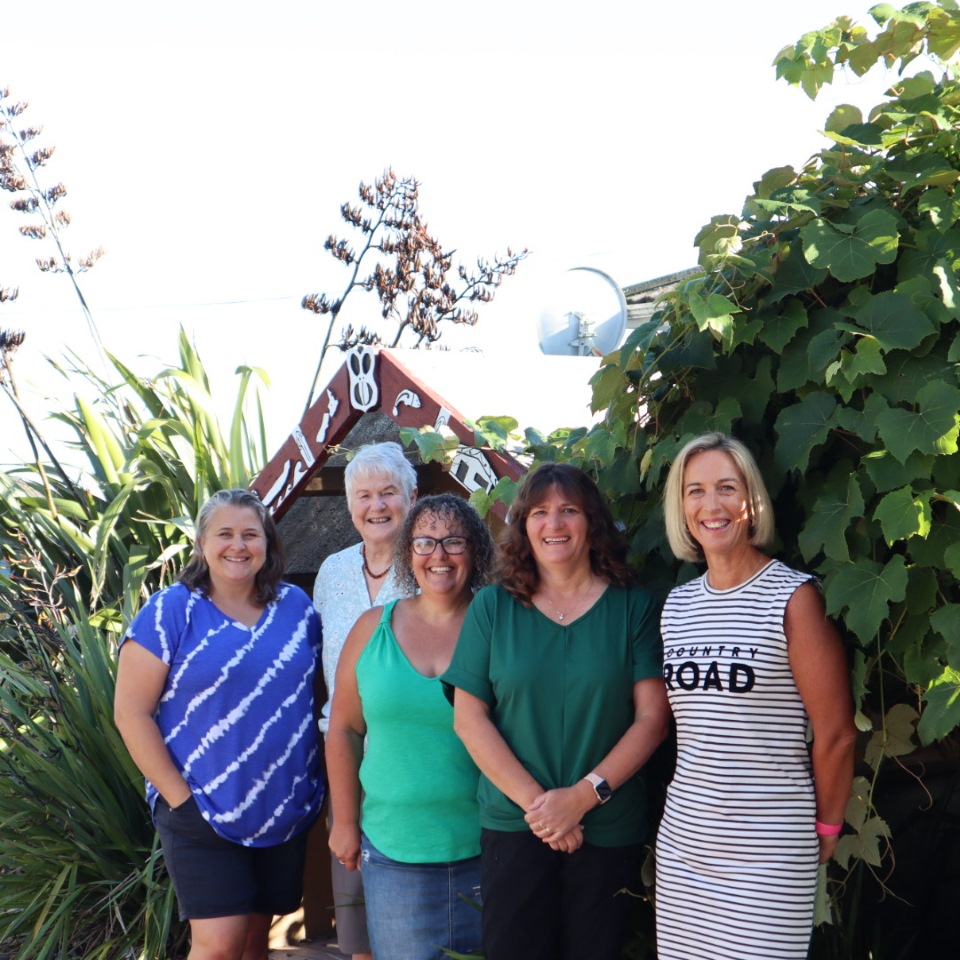
Nikki Smith, Tumuaki of Granity School on the West Coast.
After many years in the classroom and in a range of leadership roles, I felt ready for a new challenge and stepped into the resource teachers: learning and behaviour (RTLB) role in 2019. The study that I completed as an RTLB reignited my love of new learning. I found real enjoyment working alongside neurodiverse students and whānau, with the He Pikorua framework shaping my practice. Its mokopuna and whānau-centred focus and commitment to whanaungatanga means relationships and learner voice remain central.
Developing a deeper understanding of how to recognise and respond to ākonga needs and strengths through the lens of He Pikorua was rewarding. This learning continues to shape the way I approach my work now as a teaching principal, grounded in partnership and shared understanding.
Balancing leadership and teaching
Granity Kura is incredibly unique, with a small roll of 31 students across two classrooms with Years 1 to 3 and Years 4 to 8. With these small class numbers, our ākonga benefit from more one-to-one teaching time.
We have a passionate and skilled teaching team and an extended team who are deeply committed to improving outcomes for all.
Being the principal of such a small kura comes with the added privilege of teaching two days a week, and they are my favourite days. The balance between teaching and leadership is one of the aspects I value most in my role – no two days are ever the same.
Throughout my career, I have observed that when stepping into leadership roles, the realities of day-to-day teaching can easily be forgotten, and this is something I remain very mindful of.
Having regular opportunities to be in the classroom allows me to stay closely connected to students and staff. The ongoing whanaungatanga and these connections help me to be a more effective and responsive leader.
Working alongside to empower
One of the most powerful lessons I’ve learned as a leader is accepting that not everyone will like you. As a recovering people-pleaser, this was a hard but necessary realisation. I felt like I was drowning, constantly trying to meet everyone’s expectations, and heading straight towards burnout.
Over time, I learned to trust my judgement and back myself a bit more, stand by my values, and let go of the need to be liked. I understood that standing by my values wouldn’t always be comfortable or well-received.
A strong support system matters – and the right people aren’t always the ones you expect. Finding those who truly support and challenge you is worth the time and effort of finding them. This may not happen straightaway, so take the time to have the right people in your corner.
Take time to find the leaders who inspire you and deliberately carve out time in your week for professional growth and reading. Tapping into the insights of others has been invaluable and refreshing. If you haven’t read Lost at School by Ross Greene, Leading to the North East by Russell Bishop or Dare to Lead by Brené Brown, I highly recommend them!
An insight I’ve gained about myself as a leader is that I naturally lead in an agentic way – working alongside people and empowering them, rather than taking a top-down approach. I’m the first to admit I don’t have all the answers, and when things get busy, my creativity doesn’t always flow the way it used to.
I believe that when staff feel genuinely supported and included in decision-making, they are more engaged. I’ve learned that I don’t need to be the one talking all the time. When I slow down and really listen – just like we teach the students – it strengthens our relationships and reminds others that their perspectives truly matter.
On any given day, I wear many hats: sorting property issues, juggling finances, making sure a five-year-old isn’t burning themselves with a hot glue gun, responding to the constant opening door of visitors, and heading into meetings after hours.
Sometimes I get more done before 8am and after 5pm than I do between 9am and 3pm. That’s why drawing on the strengths of our team is so valuable. It’s all part of the juggle, demanding and at times complex, and a reminder that none of it can be done alone. Empowering others and delegating is essential; though understandably, delegation can be tricky in a small school.
In those moments, I’ve learned to park things, return to them later, and be comfortable with that.
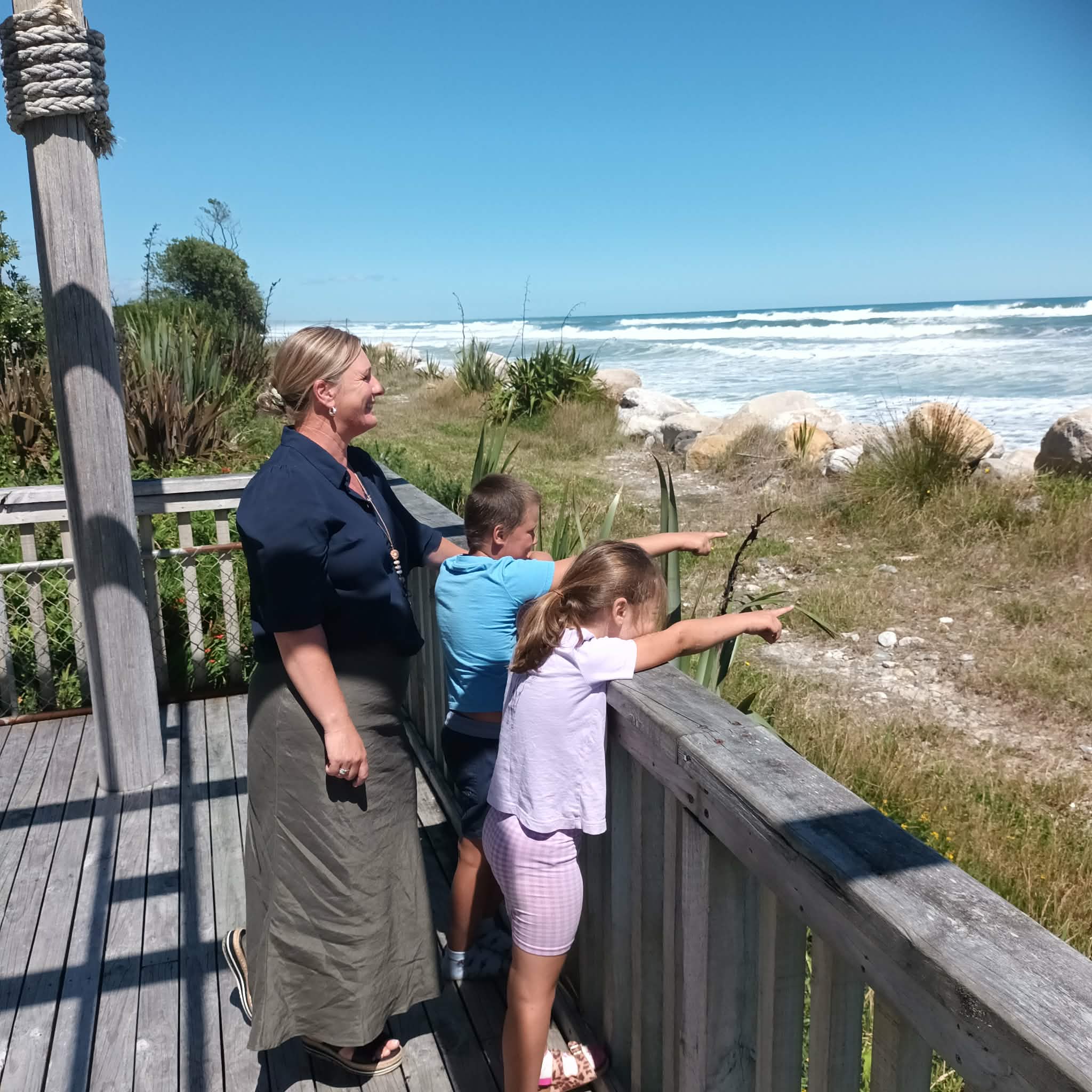
Nikki watches dolphins from Granity School’s verandah with ākonga and siblings Keith and Stephanie.
A leadership style shaped by a unique school
My leadership style is deeply shaped by our school’s special character and cultural identity, particularly our commitment to inclusion, belonging and wellbeing.
When I first stepped into the role of principal, my personal goals aligned closely with the school’s vision: that every child would thrive and experience success, regardless of their differences.
Our school vision, ‘Empowering curious minds, Whakamanahia ngā hinengaro māhirahira’ is not just words on a page for me – it guides how I lead, the expectations we set as a team and the way we show up for our students.
At Granity School we empower and prepare our tamariki by teaching them to value learning, identity, community and place.
I aim to lead in a way that creates a safe, supportive environment where students feel seen, heard and confident to ask for help when they need it. It’s not always perfect, and we don’t always get it right, but we continue to reflect, learn and improve as a team.
It was powerfully affirmed in the final weeks of term 4, when a student came to my office and said, “Mrs Smith, I think I need you to be my external brain, can you help me?” That moment meant everything to me. It showed that this student felt safe to advocate for himself and trust the adults around him. We were able to talk through what was happening for that student and put support in place that respected his individual needs.
Moments like this reflect the culture our team is intentionally building – one where empathy, inclusion and partnership sit at the heart of leadership, learning and relationships.
Intentionally creating space
There is no doubt that 2026 will be a year of learning for all of us, with significant changes to curriculum, assessment, and reporting, alongside ongoing expectations around attendance and other priorities.
While the pace of change may feel challenging, I am confident that by working together as a team, we will navigate what needs to be done in a way that works best for our school.
A key goal moving forward is to continue supporting and growing our staff. I want to further strengthen a collaborative culture where staff feel valued, listened to and supported, and where individual strengths are recognised and utilised.
By intentionally creating space for professional growth, reflection and open dialogue, we can continue to improve outcomes for our students.
As we move through this change, my focus will be on taking small, manageable steps rather than trying to do everything at once, and on leaning on the expertise within and beyond our school for support.
I choose progress over urgency, knowing that things don’t need to happen all at once to still move in the right direction. Sometimes the most productive decision you can make is to shut the laptop, go home, and recharge.
Whānau comes first – including yourself. I don’t want to finish 2026 as exhausted as I did in 2025. In those final weeks I found myself thinking, ‘that will be a 2026 problem’ – so there’s already plenty to get stuck into this year!
I’m committing to taking my own advice. When we care for ourselves, we show up stronger, calmer and more present for our students, our colleagues and our whānau.
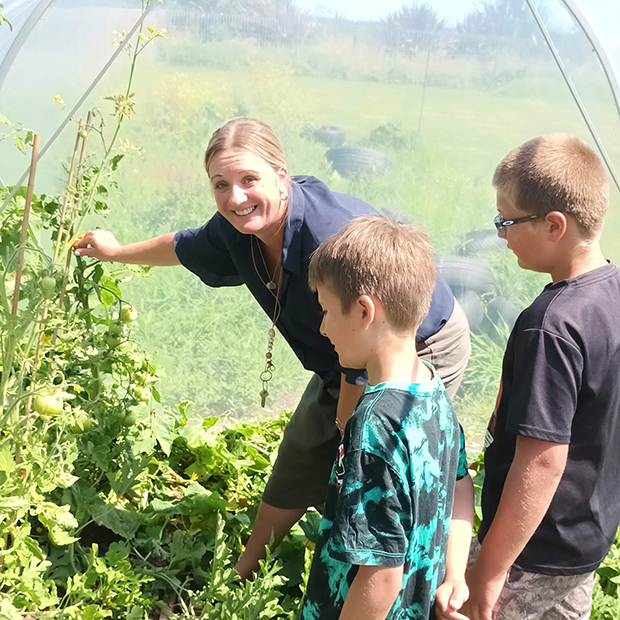
Nikki with students Dyllen and Hayden in Granity School’s greenhouse.
Nick Rate, Tumuaki, Russell Street School – Palmerston North
I have been a principal since 2012, and tumuaki of Russell Street School since July 2017.
As a student teacher and then a beginning teacher at Russell Street, I have gone full circle. Initially, I taught here for four years at junior and middle level. Then I moved to a facilitator role for an information and community technology professional development cluster where Russell Street was the lead school.
In 2002, I moved to Japan and taught at Yokohama International School, returning to New Zealand – and to Russell Street – as the deputy principal in 2006. That was followed by a Ministry of Education eFellowship in 2008, and in 2009 I went to work in a national facilitation role for Core Education.
It was such a privilege to work there and be in and out of schools across New Zealand. I saw so many great school leaders and teachers doing amazing things. It confirmed to me that leading and working alongside others in a school was something I wanted to be part of and develop myself further in.
The lure of being back in a school saw me get my first principal job in 2012 at Kumeroa-Hopelands School Woodville, followed by two more rural schools, Oroua Downs and Newbury in Manawatū and finally, in 2017, Russell Street.
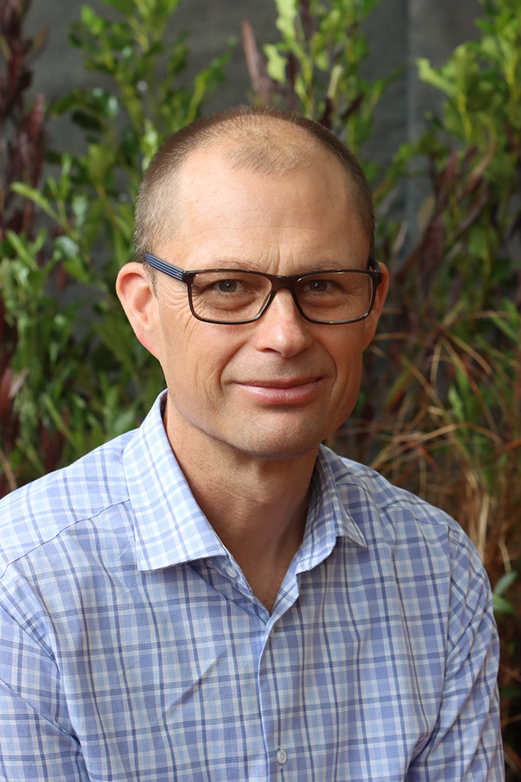
Nick Rate, Tumuaki of Russell Street School in Palmerston North.
Prioritising the voice of whānau
Our school has 10 values, so we are a little different than most schools which usually have four or five. All 10 uara are crucially important for us as a school. The presence of uara has lifted in our school over the last eight to nine years. We have made great strides in how they embrace their kaupapa Māori, and are immersed, taught and recognised in the everydayness of our school.
We are also really proud of how our school has responded to the voice of our whānau in the establishment of Poutokomanawa, our level 3 Māori immersion space.
This was initially a small Year 4 to 6 class working at level 4 but has now grown to 100 Year 0 to 6 students across four classes with a waiting list of interested students. This is such a great testament to how the school has prioritised te ao Māori and actively responded to a need.
Cultivating ‘pumanawatanga’
Taking on facilitation roles such as with Core Education deepened my philosophy around education. It affirmed beliefs but also challenged them.
It allowed me to feel the intangible vibe, culture and pulse of great schools as soon as you walk in the front door – this vibe, or as we call it at Russell Street, the pumanawatanga – is something that we actively cultivate.
Working overseas is also a great experience on so many different levels. There is the international context of living and working overseas and being an ethnic minority. There’s also the certainty and stability of the International Baccalaureate (IB) curriculum, how schools respond to diverse student body in learning, culture and social areas.
When I have visited international schools more recently, it reinforced all of this; but more than anything the stability of IB Primary Years Programme curriculum struck a chord with me, especially how little it had changed in 20 years.
I visit other schools at least once a year as part of my principal professional learning group. I talk to other school leaders, learn, reflect and wonder. This significantly influences my understanding of what is important for other schools, how they go about navigating the challenges in education, exciting innovations, and ways of working. From this, I look at how these may be used and embedded in what we do at Russell Street School.
My key goals this year are around staying true to what we believe is right for our school and students, especially with the ongoing change in the sector. Some of the words to describe our intent as Pūmanawa (the name of our leadership team) this year are courageous, bold and optimistic. I have a personal goal to make sure we remain grounded, balanced and ‘measure what we treasure’ in relation to capturing the progress and achievement of our students.
A networked approach
I have been lucky to work alongside and learn from exceptional educators in all my roles as a teacher, principal and facilitator. I am humbled at Russell Street School with the calibre of kaimahi who do so much for our students. I learn so much from them and try to do everything to give them the right conditions to thrive as educators.
The concept of a networked approach to leadership captures my beliefs around leadership and how I approach my role. A network approach is collaborative, strengths-based, timely, responsive, flexible, and values everyone.
I also read a lot of books to support my continuing learning. Currently on the reading list is Invisible Intelligence by Welby Ings, and When the Adults Change, Everything Changes by Paul Dix – two powerful reads. Books, like school visits, are such a great way to learn, reflect and wonder. I am privileged to be surrounded by great people – they make the job fun, rewarding and doable.
A leadership style that embraces trust
At Russell Street, staff embrace our culture of professional trust and autonomy. They are trusted to make key decisions about what is best for their students. My role is to give them the space to try new things and follow their passions.
Empowered kaimahi results in great learning. Happy staff means happy ākonga, and that means happy whānau.
Kaimahi are allowed to be themselves, and that is very influential on our school culture and vibe. The voice of staff in making decisions and being part of all reviews, planning and strategic direction is also highly valued. Engaging in dialogue and decision-making with and alongside staff – not for staff – is a priority for me and how I lead.
I am also a calm, quiet person – definitely not your loud, out there, centre of everything, commanding presence on a stage type. This flows through to my leadership style which is calm, relaxed, unflustered and quiet – all balanced with being highly reflective. I think that goes a long way to establishing and influencing the culture of a school.
Be yourself, know who you are as a leader. Don’t try to lead like someone else – do it your way.
Alistair Luke, Tumuaki, Whangamatā Area School – Coromandel
Now in my 10th year as principal of Whangamatā Area School, I originally trained as a secondary English teacher. I started my teaching career in Rotorua, the city where I grew up. After that I spent three years in the United Kingdom before returning to New Zealand to settle for what we thought would be for a short period of time, in Whangamatā.
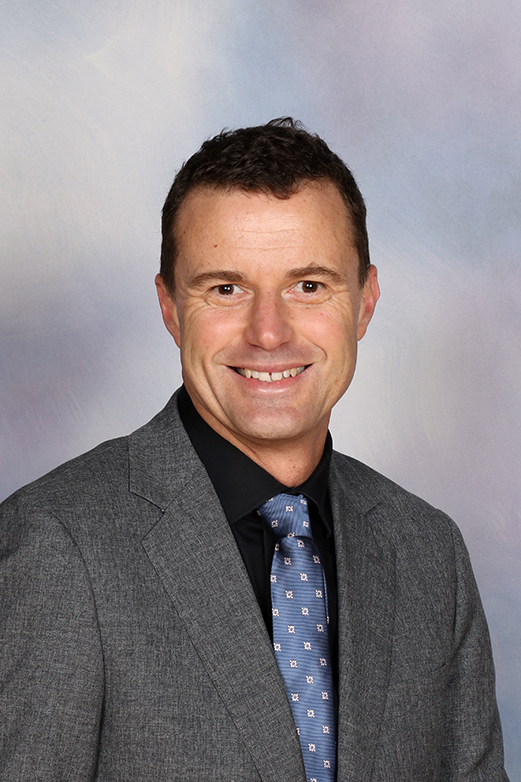
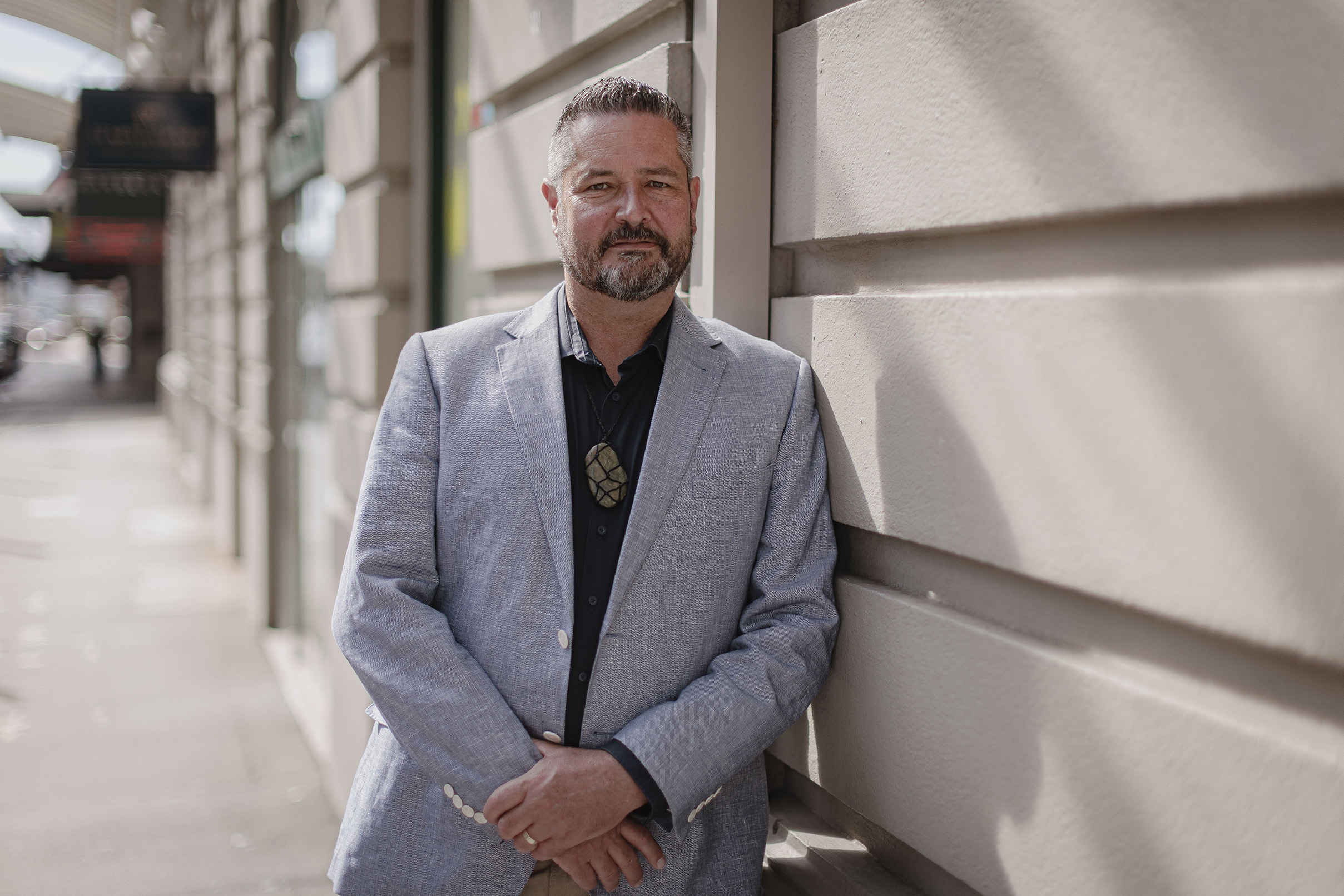
Alistair Luke, Tumuaki of Whangamatā Area School in Coromandel.
I have been fortunate to have been presented with a number of opportunities for internal promotion at Whangamatā Area School. Ultimately, that journey culminated in becoming principal in 2017.
I was fortunate to be encouraged by a number of good people along the way, and I really enjoyed the Aspiring Principal Programme. A door opened at a particular time in my life and career, and I decided it was ‘worth a shot’.
Area schools: A unique and innovative school journey
Area schools are unique in that you have the entire schooling journey in front of you. We see many ākonga here walk in the door as five-year-olds, and out the other end as school leavers 13 years later.
The idea that you have full influence over that journey is a powerful one.
Area schools are so diverse. This means you have to be aware of how you communicate with a diverse range of stakeholders. A five-year-old takes messages very differently to how an 18-year-old consumes them. Full school assemblies are very interesting in this regard.
I also think by nature of their relative remoteness, area schools are constantly innovating and seeking points of difference.
We have an amazing natural environment in Whangamatā and being able to shape aspects of our curriculum around that is incredibly exciting and fulfilling.
Challenges and opportunities in an evolving leadership role
In principalship, you never quite know what challenge or opportunity might present itself on any given day. We think hard about strategy, but also have to be responsive in the moment, when various issues pop up.
I think I have learnt that when those big challenges arise – Covid taught me a great deal here – people around you look to you for calmness and considered responses.
Leadership style constantly evolves. You take little lessons from every situation you encounter.
Sometimes when you come across something new that excites you, it can be challenging to present that in a way that remains consistent with the values and decisions people have come to expect from you.
There is a balance to strike between innovation and consistency because ultimately the people around you respond best when they know what to expect from you as a leader, so that consistency is really important.
Consistency is huge. I know I don’t always get this right, but it is important to reflect and ask if the decisions you are making are anchored in the values that the school carries, and that you have articulated this as a leader.
Staying ahead of the curve in 2026
This year, we are consolidating a number of initiatives that we have been part of in the last few years. In many ways, this is a year of bedding in. We are always trying to stay ‘ahead of the curve’ in terms of our NCEA and University Entrance results, and that remains a key priority for us.
To build cultures that are both responsive to change and grounded in strong values can be challenging. Spend time considering the changes that are most important to your school and making sure those are prioritised and well-resourced internally.
We have very little control over the external funding and resourcing we receive, so how we use what we receive is critical.
It can be easy at times for staff to feel overwhelmed with competing priorities, or the volume of change that may be necessary at any one time. A leader’s responsibility is to sift, filter and prioritise, demonstrating strong and clear strategic and change management.
Just trust yourself. If you are acting in the best interests of the students in your school and the educational needs of your community, then you are doing a great job.