Twizel Area School opens its new chapter
Grounded in the past and designed for the future, the opening of a rebuilt area school in Twizel marks a major milestone for this resilient community. A former student, this writer blends local history with student and teacher voices to reveal what the new spaces mean for learning and community life in the beautiful extremes of the Mackenzie Basin.
In 1968, Ministry of Works trucks, loaded with materials to build cottages and prefabs for schools, rolled onto farmland in the Mackenzie Basin.
There, on the flat land among the tussock, they built a little town to house the workforce who came to build the Upper Waitaki power project – a series of power stations from Lake Pukaki to the Waitaki River.
At the height of the hydro boom in the late 1970s, the primary and high schools taught a thousand children from all over the Mackenzie Basin, but by 1983, once the power plants were built, many families left to find work elsewhere.
The Ministry of Works’ intention was to dismantle Twizel and return it to farmland.
But the remaining families had fallen in love with the area and successfully lobbied to let the little hydro town stay. The schools were amalgamated into an area school of just 150 students, both schools now sharing the high school buildings.
Today, a new Twizel Area School with 250 students has been rebuilt to withstand the freezing depths of Mackenzie Basin winters and the searing heat of its summers.
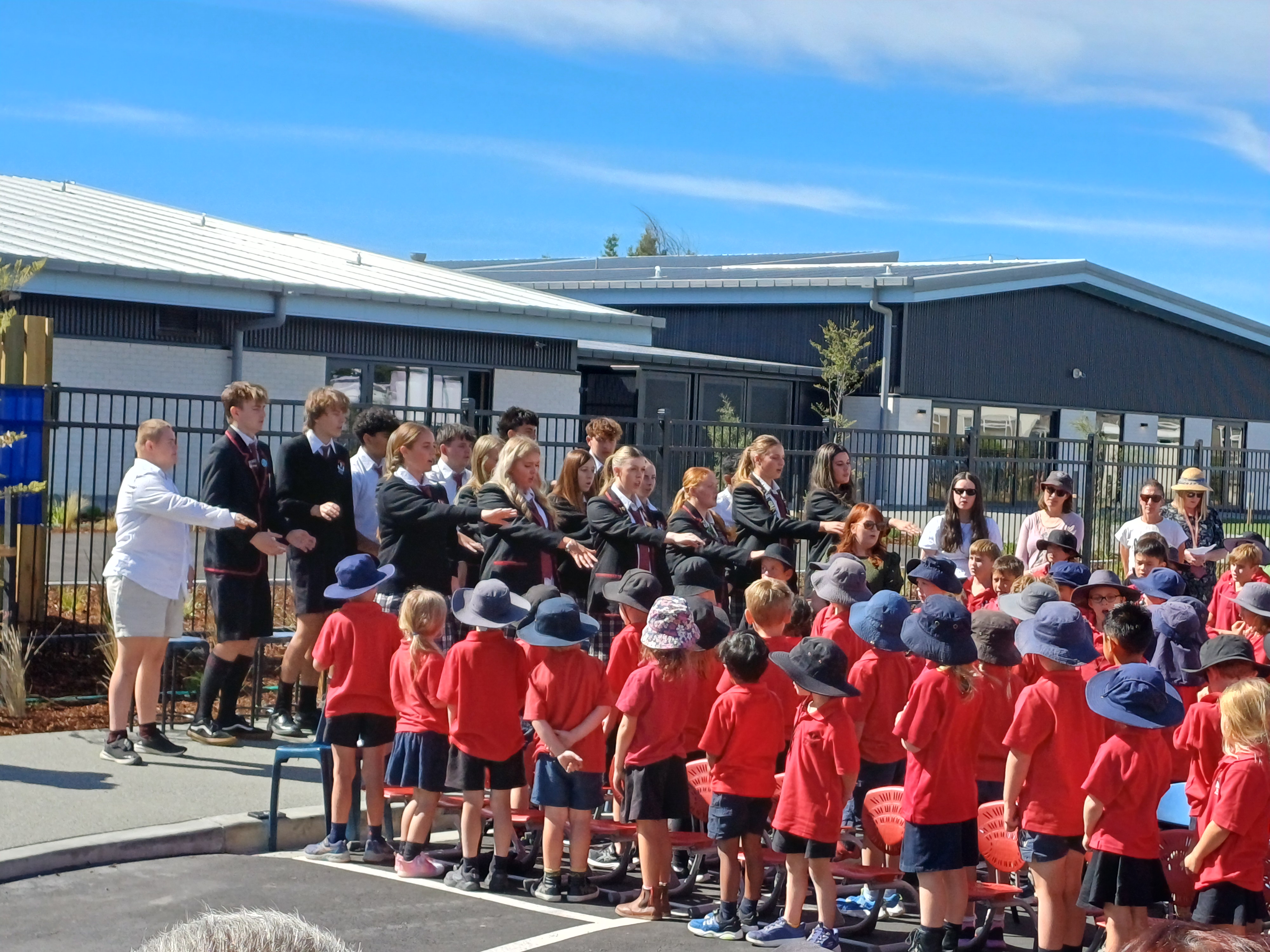
A blessing ceremony led by Kai Tahu sets the tone for the chapter ahead.
The opening pōwhiri at Twizel Area School
Setting the scene
At the centre of the new building is a modern, light-filled library with a glimpse of Aoraki Mt Cook in the distance. It is principal Vicki McIntyre's favourite feature.
Study spaces and comfortable chairs are dotted among racks of books with lines of classrooms radiating off east and west.
“You'll see five-year-olds curled up reading, with seniors studying right next to them. And that’s how an area school should be.”
The Mackenzie Basin is breathtakingly beautiful. The little town is cocooned by hills with flowing golden tussock. Snow-capped mountains peek over the top and shimmering alpine lakes and rivers promise adventure and excitement. The air is crisp and fresh.
At night, the Milky Way and its millions of stars is astonishingly close and magical.
Inside the new school, waves frosted onto the lower halves of the windows separate the teaching spaces, but they still feel connected to the rest of the school. They bring a sense of movement and reflect the blues of the glaciers, lakes, rivers and big wide-open skies of the area.
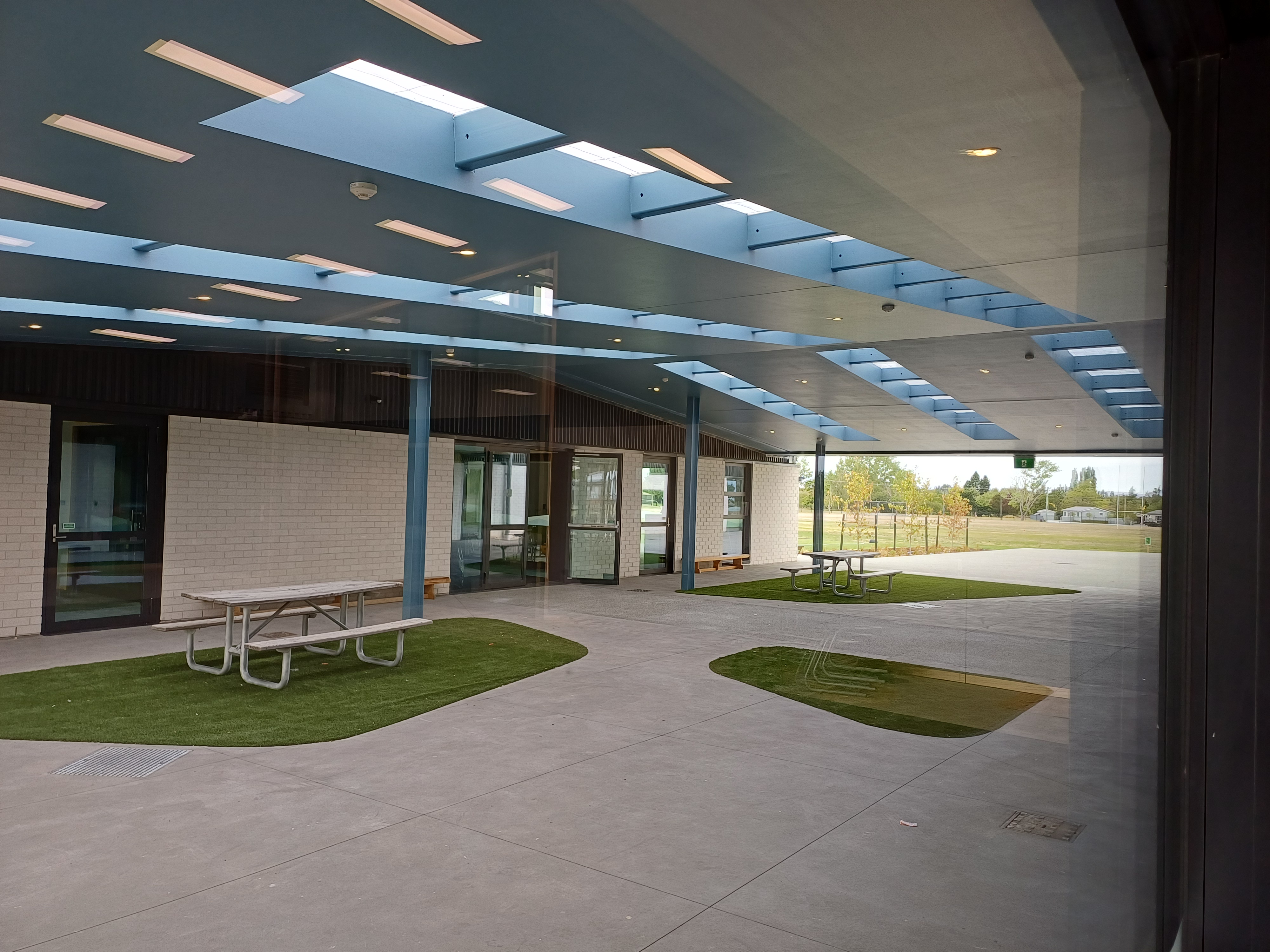
An undercover outdoor area at the school
To celebrate the new school’s opening, the students have painted colourful bunting flags which decorate the wide hallway that runs the length of the school – all depicting the beautiful scenes that surround them.
A climate of extremes, the Mackenzie Basin has been known to get as cold as -10 degrees, though usually sits around -3 to -4 degrees in winter, climbing to the late 30s in summer.
The new Kingspan roof is designed for both extremes with a high thermal rating and a substantial snow loading, and is also built to withstand high winds. The walls have climate-specific insulation, and the windows are double-glazed and thermally broken, which keeps the internal temperature consistent.
The ceilings each have ventilation units connected to a central air conditioning system which pumps warm, fresh air through the school, but also allows teachers to adjust the temperature in each classroom.
New spaces and opportunities
At the far end of the new complex is the Multi-Purpose Room, (MPR) also festooned with colourful bunting. It's set within a network of music practice rooms – a luxury the school has never had before.
Jayne Evans teaches maths, science and music and is developing the arts and music curriculum. She has big plans for the space and can't wait to set up a music programme.
“I'm excited that this year, Years 7 to 10 are all taking music, drums, or performing arts with me.
“I would like to see a minimum of 20 senior students studying music and drama in the school. I want to see the middle school have a full drama class at each year level.
I want to see all the primary school kids doing Ukulele Jam, get them up on stage doing some performances. We'll have drama games at lunchtime!
A significant shift
Melissa Sidon teaches English and is the dean for Years 7 to 13. She explains the difficulty they had building school pride in the old, and cold, space.
“On days when it was too cold to go outside, [students] were in the foyer, outside the office and that would be [all year levels] ... Students would have the odd game but usually they were trying to keep warm in the foyers which became a 'managing students' challenge. The new school has numerous spaces and indoor-outdoor flow.
It was hard for the students to care about the old school, it was run down, rotting, cold and unwelcoming, but they're certainly proud now – and excited to come to school.
Though rewarding, the shift has been demanding for all involved. For months, staff laboured for hours after school, moving endless boxes of teaching materials from the old buildings to the new space.
Sandy Nelson who teaches English and social studies, says it's been a huge effort to shift, even though the buildings are very close.
Reflecting on the old, though slightly gloomy, interiors, Sandy also speaks to a sense of pride in the past, and the weathered resilience built through the generations.
“Quite a lot of our students are from families who have been here for three generations – their grandparents fought the Government to keep the town.
It's a special place to teach.
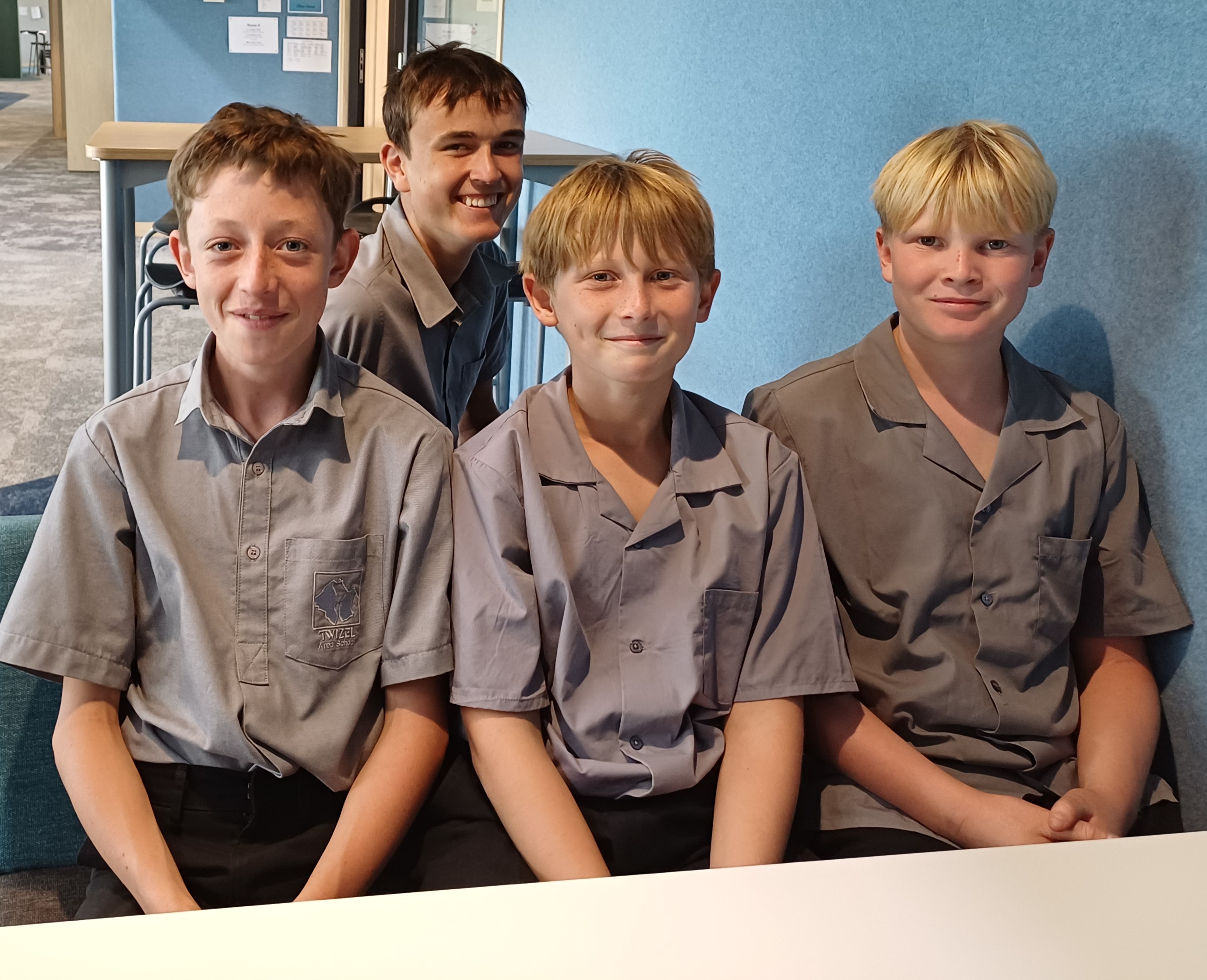
Twizel Area School students from the middle school.
Grief for the old, hope for the new
A ribbon-cutting ceremony officially opens the space, with native trees planted by the youngest and oldest students.
The atmosphere is festive, but classes continue among the celebrations.
Elyh, Fletcher, Baxter and Dominic are full of 12-year-old bluster and cheekiness and enjoy sharing their dreams for the future.
Two plan to become fishing guides, one intends to become an engineer like his Grandad, while the fourth thinks he might work in a bar.
There's this guy in town, says one. He goes out guiding, teaching people how to fish and I go with them sometimes. I just want to do that when I grow up.
When asked if they are happy to be in the new school, it’s mostly enthusiastic nods with some sadness for the only space they've known until now.
It's really cool, says one. It's not as confusing as the old school. The hallways are bigger and there are lots of windows. It's easier to find your class.
I hope it's a lot warmer than the old school though,; says one emphatically, Because that school was really cold!
They’re looking forward to getting a new playground and a basketball court. And they grin enthusiastically at the thought of their own gym for winter sport.
Head girl Lily reflects on how it was colder inside the old school than outside some days.
“The heaters were old and took ages to warm up. Having all these new heat pumps is going to be great for winter.”
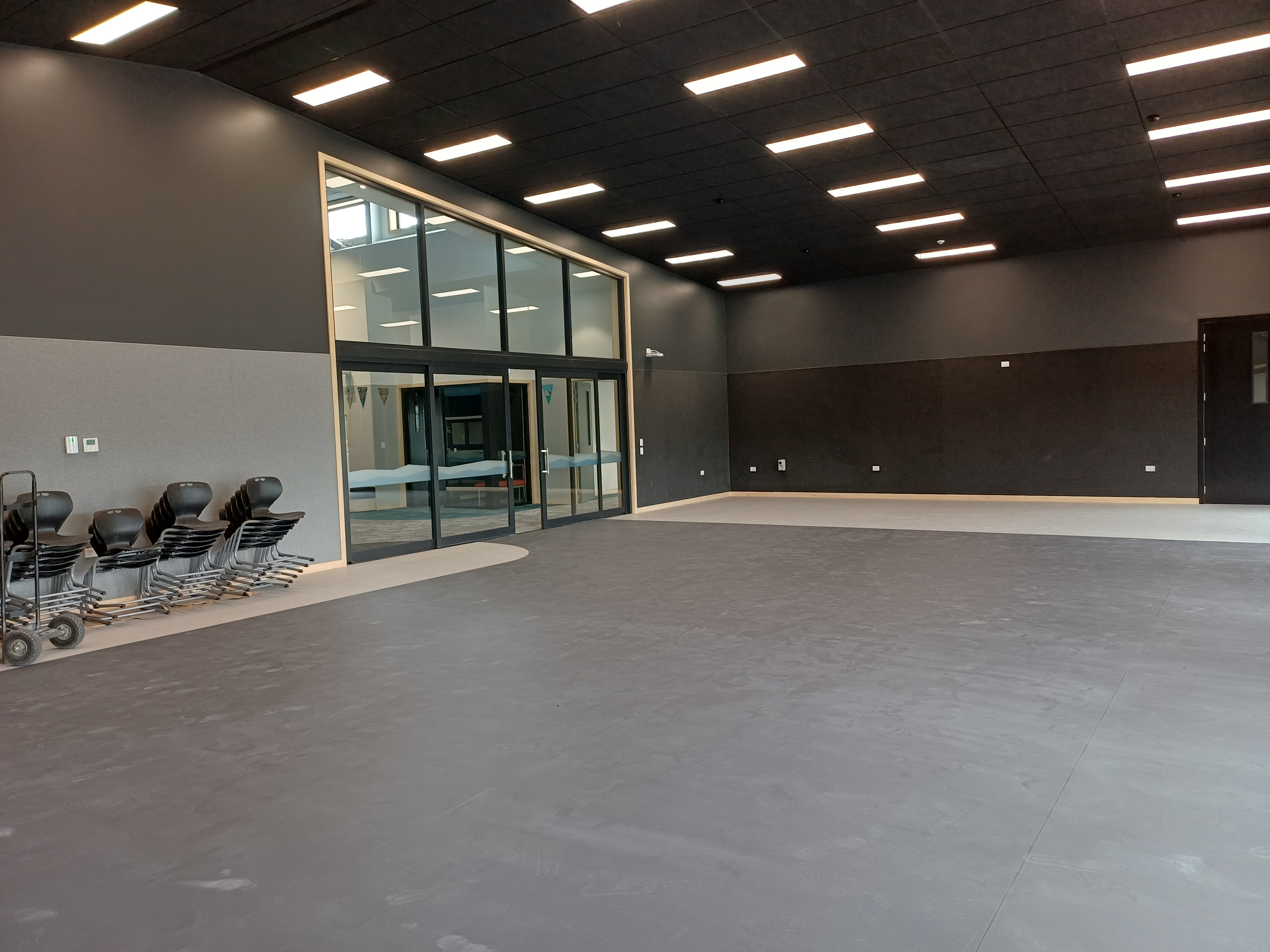
Twizel Area School's new multi-purpose room (MPR)
Like the juniors, Lily is also a bit sad to see the old buildings go. She tracks her progress through school by those old classrooms, including years when it was hard to turn up. But Lily is proud of what she's achieved.
Who would have thought I’d have got head girl? There were teachers who believed in me and took an interest in what I wanted to do. They helped me... respected me, listened to me, wanted me to be there and to have a good learning experience.
The students agree that at the end of the day, it’s not all about the bricks and mortar.
“It's the people. It's the teachers that make it a good school. But the new school helps a lot,” says Lily.
Ready for the next generation
At the ribbon-cutting ceremony, the Mackenzie District mayor, Scott Aronsen, told students, parents and teachers the population in the wider Mackenzie Basin is set to double in the next 20 years from the current 5,500 permanent residents, driven by tourism.
It’s already hard to book a bed in Twizel. The demand for more accommodation is expected to attract hospitality workers to the district to manage those businesses and in turn, more eateries and shops.
With year-round skiing, hunting, fishing, tramping and other outdoor pursuits so close, those workers are likely to stay, put down roots and like many before them, have children who will go to Twizel Area School.
Vicki McIntyre and her board and teaching staff are ready for them.
The details
- School roll: 250.
- What was built: Two new standalone single-story buildings and a carpark.
- Number of classrooms: 12, plus a specialist block.
- Construction cost: $21 million.
- Build time from day one: 10 months.
- Building company: Southbase.