Growing clarity and confidence in mathematics across Auckland schools
The refreshed New Zealand Curriculum: Mathematics and Statistics came into effect on 1 January 2026. In preparation, a group of schools on Auckland’s North Shore asked a practical question: How do we translate the new curriculum into clear, coherent and workable steps for teachers to integrate in their day-to-day practice?
Mathematics Scope and Sequence (Years 0 to 8) is a comprehensive planning resource developed collaboratively across seven schools.
These schools were members of the former MidBays Kāhui Ako, a North Shore Auckland-based community of learning comprising early learning centres, primary, intermediate and secondary schools.
Although communities of learning funding shifted for 2026, the schools remain banded together to collaborate on best practice and continue to deliver on the needs of their thousands of students. They include:
- Rangitoto College
- Browns Bay School
- Campbells Bay School
- Mairangi Bay School
- Murrays Bay Intermediate School
- Murrays Bay Primary School
- Pinehill School.
Aligned to the refreshed curriculum, the Mathematics Scope and Sequence provides detailed, year-by-year guidance on what to teach and when, while preserving teachers’ professional judgement.
“The new curriculum is much more detailed, which is great,” says Lauren Walles, MidBays numeracy team leader and mathematics teacher at Rangitoto College.
“What we have done is unpack it into clear, visual sequences so teachers can see how learning builds over time.”
Organised around the curriculum’s six strands – Number, Algebra, Measurement, Geometry, Statistics, and Probability – the full resource spans approximately 270 pages, with sectioned-off chapters covering Years 0 to 8, with reference to Years 9 to 10 extensions.
Each year level includes structured annual planners, term breakdowns, clearly defined skills aligned to the national curriculum, key vocabulary, examples and diagrams of each skill, suggested teaching time, and space to track coverage.
Strand progression posters visually map when concepts are introduced, revisited, and consolidated.
“We have made the sequencing explicit. It supports collaborative planning by helping teachers see where students sit within the progression and identify when they’re working above or below year-level expectations,” says Lauren.
For principals, the visual mapping strengthens alignment across schools.
“They make professional conversations much easier. You can see how learning develops from Year 0 through to Year 8. It supports alignment to national expectations without taking away flexibility.”
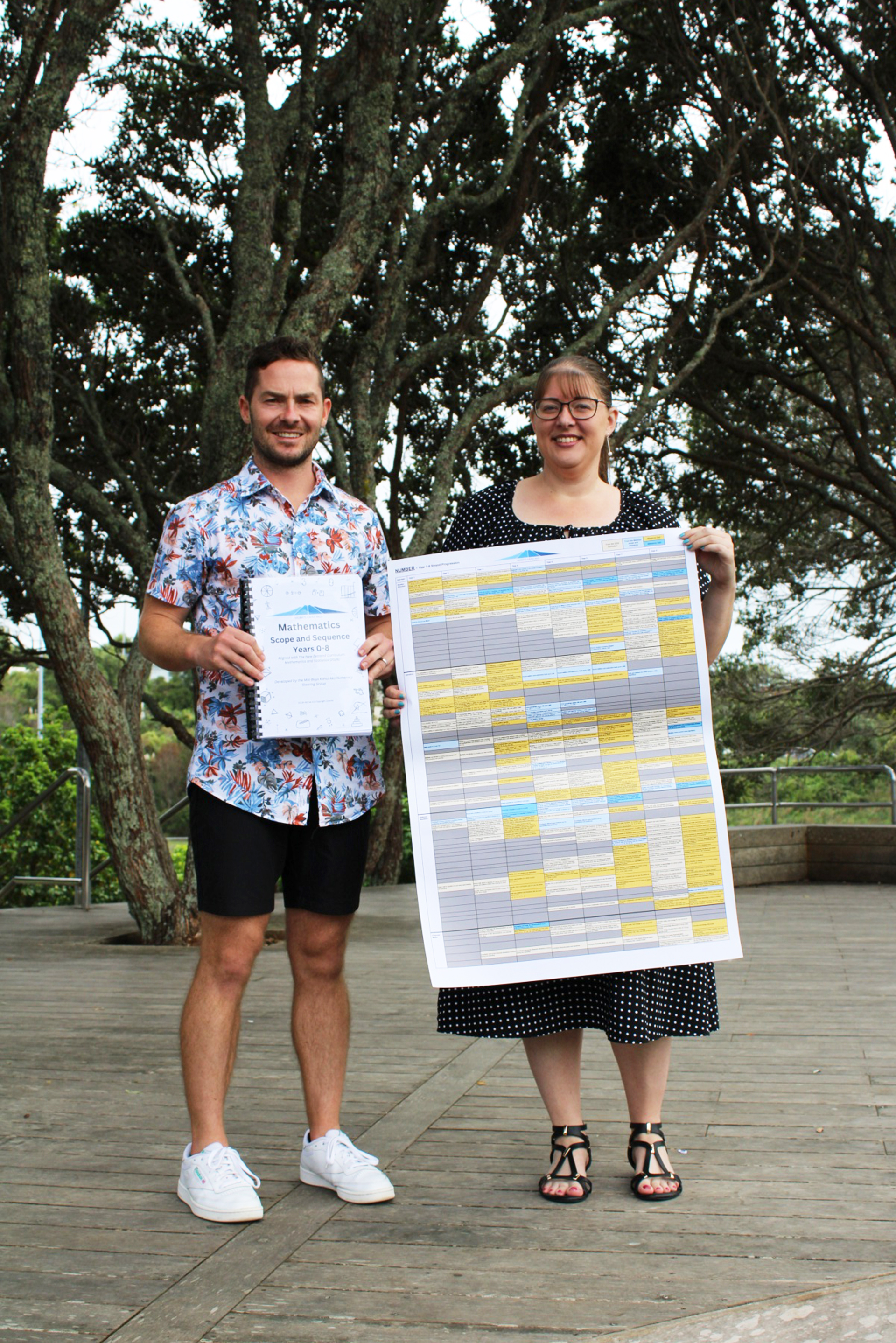
Liam Cunningham and Lauren Walles with a visual sequencing diagram from the resources.
Grounded in the science of learning
The Mathematics Scope and Sequence is grounded in key principles from the Science of Learning; including careful sequencing, cognitive load management and regular review.
“We were very conscious of cognitive load. If you overload students with too many new ideas at once, you reduce the chances of long-term retention. That is why sequencing out their learning matters,” says Lauren.
Teachers are encouraged to plan for one hour of mathematics each day, she adds, with balanced coverage across strands and deliberate revisiting of prior knowledge.
“When sequencing is built into teachers’ planning documents, it is much easier to consistently implement a comprehensive programme,” says Lauren.
“The resource package is structural, not prescriptive. It does not tell teachers how to teach. Instead, the planning resource provides a clear framework that supports teachers to secure the prerequisite knowledge of students before more complex concepts are introduced. This helps reduce learning gaps across students’ school journey.”
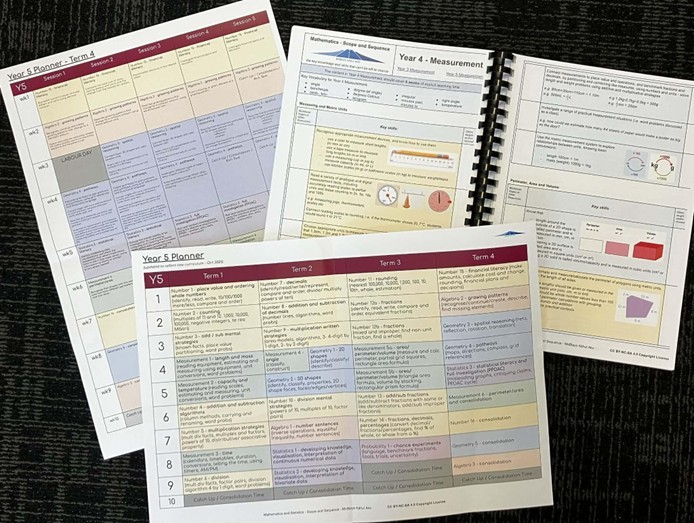
A range of free Mathematics Scope and Sequence planning resources for teachers.
Visible progression
Progression is made explicit from the earliest years. For example, in Year 1, students work through number structure up to 100, addition and subtraction facts, early multiplication and division concepts, fractions, measurement, geometry, algebraic patterns and data.
Each area includes key vocabulary, suggested timeframes, and prompts for reflection.
“When creating the planning resources, we asked ourselves what new teachers stepping into their first classroom would want to know,” explains Lauren.
“We did not want teachers having to research every line of a curriculum document. We wanted the information clearly laid out in one place.”
As students move through Years 4 to 6, the focus of the New Zealand Curriculum set out by the Ministry of Education shifts to modelling operations, building fluency with fractions and decimals, and applying reasoning to more complex problems.
By Years 7 to 8, students are working with algebraic notation, generalising patterns, operating with integers, and evaluating data.
“Making that progression visible through diagrams and sequencing in the planning resources helps teachers see what they are teaching this year, but also where it is heading within the broader national curriculum.”
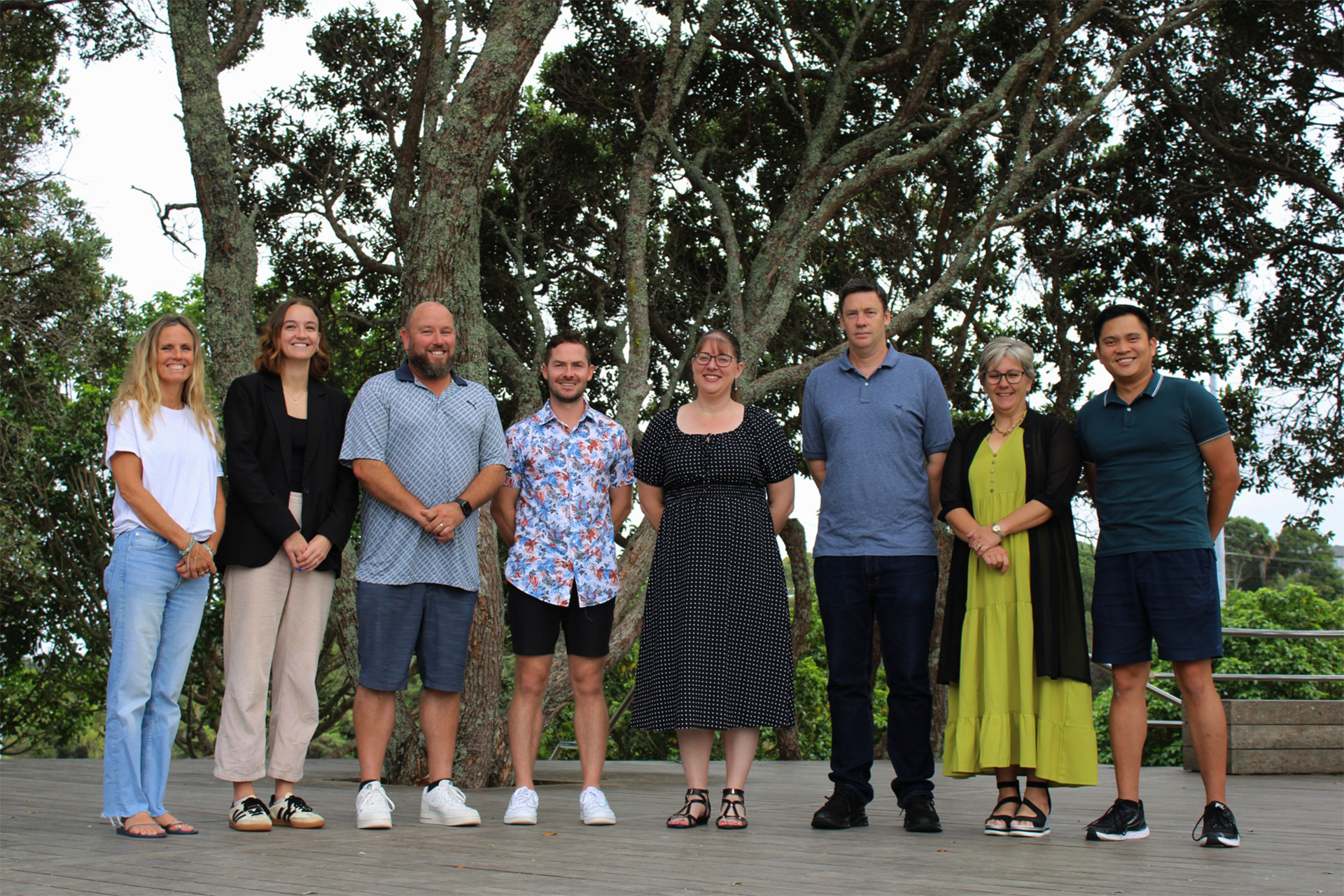
Members of the MidBays Numeracy Steering Group.
Leading long-term change and confidence
The MidBays Numeracy Steering Group comprises 15 teachers with both subject expertise and the credibility to lead change, representing one secondary school, one intermediate and five primary schools across Auckland’s North Shore.
From the beginning, strong leadership alignment underpinned the development of the planning resources, says Lauren.
“Teacher representatives from each school needed to be people their colleagues would respect and listen to.”
Lauren led the drafting process, sharing updates with the wider steering group twice each term to test ideas and refine the detail.
“I was bringing the progress back to the group to ask: ‘What do you think? What needs tweaking? What will work in your school?’
“Having one or two people steering the ship keeps the work consistent. But it was just as important that teachers from every school across our community of learning were represented – that is what gave it legitimacy.”
Early feedback suggests the implementation of the resulting curriculum planning resources is strengthening teacher confidence and consistency across the MidBays group, says Lauren.
“One early-career teacher described it as the missing piece she wished she had at the start of her career.
“It meant she could spend less time working out what to teach next, and more time understanding where her students sat against the national standard so she can refine her practice to support their progress,” she explains.
Lauren says the real benefits of the resource are for the students.
“We aimed to provide teachers with what to teach and when to teach it, allowing teacher planning time to be most efficiently spent on the best pedagogy strategies to meet the needs of the students in front of them.”
These planning resources have been shared freely online under Creative Commons licensing to encourage wider uptake in schools on a national scale.
“We would love as many schools as possible to be working from something similar. If we can reduce duplication of effort across the system, that is a good thing, and we are proud to have contributed to that effort,” concludes Lauren.
You can download the resources on Google Drive.